


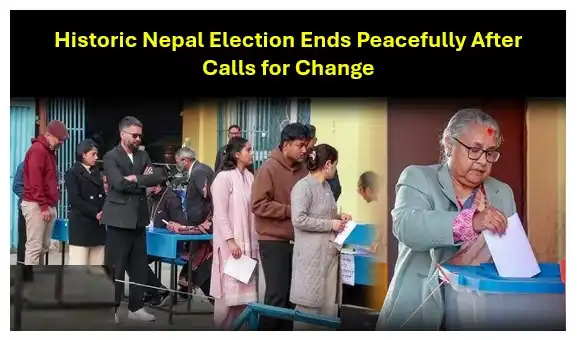
Younger voters are becoming more important, and this election ended peacefully and without major problems. This result was praised by experts both in and outside of the United States.
For many voters, especially those from Generation Z, this election was about more than just choosing elected officials. It was seen as a chance to shape the country’s future after years of growing public desire for change, openness and business opportunities.
Peaceful voting is a big step forward
Large numbers of people in Nepal cast their votes, and officials said the election process ended peacefully. Based on what polling places reported early on, it looked like voting went smoothly, with no major problems reported on election day.
The calmness before the election was in stark contrast to the smooth running of the vote. Young Nepalis held large protests in the weeks leading up to the election. They wanted better chances for the youth, a change in the government, and changes to the economy.
read also:
- PM Modi Scripts Digital History Becomes First World Leader
- How Modi broke down walls between India Israel
People in Gen Z who vote and want change
One thing that has made this election unique is the role of younger voters, especially those from Generation Z. This group, mostly people younger than 30, has become a loud voice calling for change and greater responsibility from government leaders.
People were angry about long term problems such as unemployment, a lack of job prospects, and the perception that politicians are dishonest.
Nepal’s acting Chief Election Commissioner, Ram Prasad Bhandari, said that the election for the House of Representatives went smoothly and with a lot of enthusiasm.
This new party, Rastriya Swotantra Party (RSP), is being led by Balendra Shah, a former rapper and mayor of Kathmandu. It is a tough opponent for the 2 biggest parties, the Nepali Congress Party and the Communist Party of Nepal (Unified Marxist-Leninist).
What does this mean for the democracy in Nepal
Nepal’s democratic system has faced a lot over the years, from political unrest to problems with its governance.
It’s worth mentioning that the vote was very quiet. It seems to show that political structures and values are still working well, even though people’s standards change quickly.
Politicians are already talking about how the energy and demands of younger voters will change Nepal’s politics, even if the new government doesn’t include those voters.
Leaders are waiting for results, and people have high hopes
Since the election is over, the next step is to count the votes and announce the final results. However, many people were hopeful that the new government would actually do something about long standing social and economic problems once it was formed. Some of these are lowering unemployment, strengthening public services, and improving infrastructure.
People close to the election said there is a broad sense of hope for real change. A particularly large number of young people saw the election as an opportunity to show Nepal’s political elite that more and more people want real action on problems that matter to them.
Many experts believe that Nepal’s policies will be affected by how the political groups handle this pressure for many years to come. Some parties are already discussing plans and promises to get younger people more involved in deciding which issues are most important to them.
Gagan Thapa, head of the Nepali Congress, is his party’s prime ministerial choice. Oli, on the other hand, is the face of the CPN (UML).
Bhandari said that the poll was mostly quiet, with only a few small events here and there.
Right now, the vote boxes are being picked up. He also said that counting would begin as soon as the poll papers were picked up.
There were 18.9 million votes in Nepal, and they chose 275 members of the House of Representatives. With first past the post (FPTP), also known as direct voting, they will choose 165 members of the House of Representatives. With proportional voting, they will choose 110 members.
People who voted will look forward to the days ahead as the results come in and new leaders take on the challenges and hopes of a changing Nepal.
