


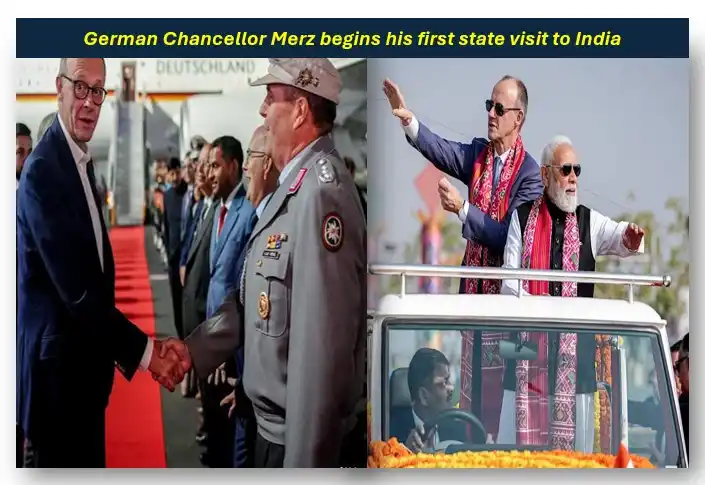
It was not just the colors of the International Kite Festival that adorned the skies over Ahmedabad on Monday. For the colourful paper “patangs” fluttering in the breeze heralded a high-flying beginning to a new chapter in Indo-German relations. German Chancellor Friedrich Merz began his first state visit to India on January 12, 2026 with a visit to Gujarat.
Symbolism runs deep during the visit, which comes as both countries commemorate 75 years of diplomatic ties and 25 years since they established a Strategic Partnership. Merz’s choice of India for his first major bilateral visit outside the European Union and NATO is a signal of turning point in Germany’s foreign policy — indicating Berlin is now looking to New Delhi as a keystone in its evolving Indo-Pacific strategy.
A Cultural Prelude at Sabarmati
Breaking with the usual formal script of a stiff protocol state visit, Prime Minister Narendra Modi greeted Chancellor Merz with an unusual mix of cultural outreach and personal diplomacy. The two leaders started the day at the Sabarmati Ashram, where they laid floral wreaths on a tribute to Mahatma Gandhi. At Sevagram, an emotional Merz sat by the tranquil ashram’s grounds and devoted himself to yielding the “charkha” (spinning wheel) as well as signing on the visitors’ book, saying he was struck by the international applicability of Gandhi’s teaching on non-violence.
The “soft power” diplomacy then moved to Sabarmati Riverfront, where the two flew kites at International Kite Festival 2026. Images of the world’s third- and fourth-biggest economies flying kites together quickly exploded across social media, a potent metaphor for two countries reaching for new heights.
The Business of Statecraft: Defense and Green Energy
The morning was celebratory, but the afternoon at Mahatma Mandir in Gandhinagar was all business. The delegation-level talks centred around converting an enduring friendship into a modern, technology-driven alliance.
There were two critical issues on the agenda:
- The P75(I) Submarine Deal: Much has been spoken of the Germany’s ThyssenKrupp Marine Systems and India’s Mazagon Dock Shipbuilders teaming up on the project. While there was no anticipation of a final signature on this trip, the leaders also discussed fast-tracking a accord to construct six advanced conventional submarines for the Indian navy with significant technology transfer in line with India’s “Make in India” policy.
- Green Hydrogen and Climate Action: Building on the Green and Sustainable Development Partnership, Merz and Modi also took stock of developments under Green Hydrogen Task Force between India-Germany. Germany wants to diversify its energy sources, and India hopes to be a global hub for hydrogen production; both countries agreed on the scope of deploying renewable technology.
Strengthening the Talent Bridge
Apart from hardware and energy, Chancellor Merz underscored the necessity for “Skilling and Mobility.” There is a shortage of skilled workers in Germany and India has one of the youngest workforces with an enormous potential.
On the dialogue table, leaders focused on speeding up talks over the Migration and Mobility Partnership Agreement with an aim to ease mobility of Indian IT professionals, engineers and high-skilled workers in the field of healthcare to Germany. Merz will be in Bengaluru on Tuesday, January 13 and undertake a tour of the Bosch campus and the Centre for Nano Science and Engineering (CeNSE) to get mingled with its tech ecosystem which is driving this partnership.
Navigating a Turbulent Global Order
The timing of the visit is not an accident. It is just two weeks before the EU’s top leadership is to visit India for Republic Day and the India-EU Summit on 27 January.
Analyzing trade disruptions and the US-China relations, the world is watching, Merz’s visit further highlights how Germany views India as a “stabilizing partner”. Both leaders also held discussions on regional security, with Merz stressing that Germany stood firmly behind India’s fight against terrorism, a point that was made and strengthened at the G7 Summit in Canada last year.
A Forward-Looking Partnership
As the state visit’s first day ended with a feast at Gandhinagar it was all smiles and mutual back slapping. Starting his Asian outreach in India, Chancellor Merz knows well that the economic future — and security of Indo-Pacific — flows through the middle of the Indian heartland.
Whether the Pink City of Jaipur or tech-hub Bengaluru, the message from the Chancellor’s visit is unequivocal: Germany is not merely a “trade partner”, but a strategic ally willing to co-create technologies of the future.
