


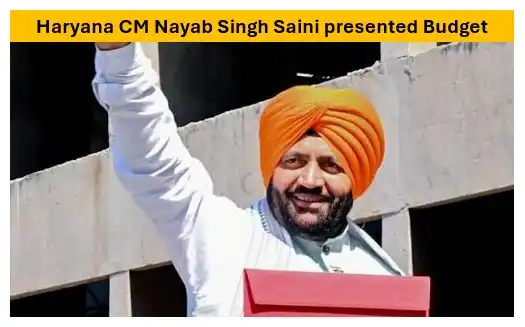
The Government of Haryana under CM Nayab Singh Saini on Monday unveiled its budget for the financial year 2026–27, with record outlays of ₹2.23 lakh crores. This represents an increase over last year’s budget. The main focus of this budget will be on building infrastructure, developing rural areas, empowering young people and providing welfare programs. All of these elements will contribute to creating inclusive and sustainable growth in the state.
CM Saini stated that the 2026–27 budget will enable Haryana to be one of the fastest-growing states in India while ensuring the state maintains its fiscal discipline. The budget will target spends in the following key sectors: Agriculture, Education, Health Care, Industry and Urban Development.
The Haryana Government will introduce new programs, in all of the above key sectors, during the budget review at the Legislature, this will support the introduction of additional capital and social investment programs.
Infrastructure and Industrial Development
A very large portion of the ₹2.23 lakh crore will be spent to improve our state’s infrastructure. The State Government has made several key investments in improving highway/accessibility networks, expanding metro systems, creating logistics hubs and developing industrial corridors to create new economic activity and attract private sector investment.
The Budget reinforces a commitment to strengthen the manufacturing ecosystem in the state, support MSMEs, and create an environment that promotes ease of doing business. In addition, startup and tech-based industries should receive incentives to continue making Haryana a destination of choice for potential investors.
According to Government of Haryana officials, capital spending on developing long-term assets will significantly increase, enabling job creation.
read more: Maharashtra announces 30 days POSH audit across offices
Push for Agricultural/Rural Development
Agricultural programs continue to be incorporated significantly into the state’s 2026–27 financial plan. There are plans to modernize agricultural methods and encourage crop diversification as well as expand the infrastructure to irrigate agricultural land.
Financially support programs for farmers (e.g., equipment subsidy; better access to credit) will become even stronger than before.
In addition, rural infrastructure projects that provide village and rural inhabitants with access to safe drinking water and sanitary systems will be funded at increased levels. The Budget also makes specific reference to dairy and other related activity sectors that enhance a farmer’s income by providing such support.
read more: Leptospirosis Outbreak Worsens in Hazara Singh Wala
Education, Skill Development and Youth Empowerment
Education and Skills are earmarked as fundamental sources of sustainable development in the new Budget, with increased allocations for both early (government school) education, higher (university) education, and technical/ vocational education and training (TVET) institutions. New funding will also be made available to provide enhanced digital learning infrastructure and upgraded facilities in schools.
To assist with increasing youth employability through skills training, there will also be increased investments in providing skills training that aligns with the needs of industry. The increased focus on vocational courses and private sector partnership initiatives will create a better linkage between education and employment.
Healthcare and social welfare remain a key priority of the new Budget. Increased funding for upgrading district hospitals, building new medical colleges, and strengthening primary healthcare is expected to receive much higher levels of funding in this Budget. Additionally, the plan is to provide better access to affordable healthcare for citizens living in both urban and rural areas.
On the social welfare side, there will be additional funding made available to assist women, seniors, and low-income households. Pension schemes and Direct Benefit Transfer (DBT) Programs will be integrated to allow for an efficient and timely delivery of benefits to eligible citizens.
Fiscal Prudence and Revenue Strategy
Although this budget will incur an increased cost to the state government, they have reaffirmed their dedication to adhering to a policy of fiscal responsibility. As part of their fiscal strategy, measures will be introduced to generate revenue by enhancing tax compliance, using digital methods for governance and improving the management of public spending.
The Chief Minister stated that this budget for 2026-27 will seek to create both economic growth and stability; that is, long term development while protecting the financial position of the state. The proposals will now be presented to the Assembly for consideration and approval within the next few days.
