


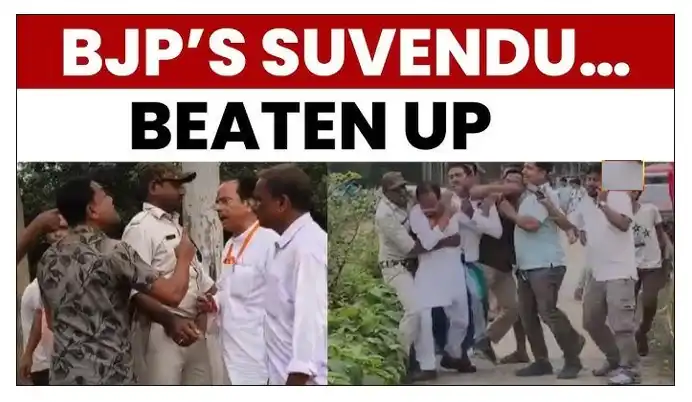
The first round of voting for the West Bengal Assembly Election 2026 on Thursday was marred by violence when members of the ruling party, Trinamool Congress (TMC), allegedly attacked a Bharatiya Janata Party (BJP) candidate in South Dinajpur, Kumarganj area, leading to newly heightened political tensions and concerns over security on election day.
Kumarganj Incident
As reported, BJP Candidate Suvendu Sarkar was allegedly physically assaulted by members of TMC while attempting to visit a booth and voting. The alleged aggressive behavior by some TMC members began after Mr. Sarkar protested against what he claims were mistakes made during voting by the the TMC; he suggested that they were trying to capture several of the booths.
In video recorded by onlookers as well as the testimony of witnesses, Mr. Sarkar was attacked and then chased through fields by a large mob He was forced to flee to avoid further injury; he was then taken to see a doctor because he had injuries sustained during the attack.
BJP Allegations
BJP stated that TMC is responsible for conducting the attack on Mr. Sarkar; Party leaders stated that the violence was part of a coordinated effort to intimidate opposition candidates and interfere with the voting process.
Sarkar claims he was attacked, in addition to damaging his vehicle. BJP officials also alleged security personnel were present during the incident, raising questions about law enforcement during polling.
also read: NCP-SP leader Sharad Pawar is hospitalized
Authorities Response
The Election Commission of India (ECI) is reportedly aware of the incident, and has since ordered action against those who were involved as a result of the emergence of video evidence.
Security has been increased in vulnerable locations, and Central Forces have been deployed at various locations, in an effort to quell any further violence. Officials have stated that strict measures are being taken to ensure free and fair polling.
also read: IAS officer Durga Shakti Nagpal suspended
TMC’s Standpoint
Although BJP has accused TMC workers of engaging in violence, TMC has not outrightly accepted the allegation as being true. TMC leaders have repeatedly countered similar allegations made against their party, by asserting that BJP has provoked conflict or misrepresented the situation when discussing these types of incidents.
The political blame game has further inflamed animosity between the two parties, with each side blaming the other for disrupting democracy.
Wider Trend of Election Violence
The attack on the BJP candidate is not an isolated occurrence. In a survey of incidents reported on polling day throughout West Bengal, instances of violence, stone throwing and numerous other disturbances were found.
Murshidabad and other parts of West Bengal saw incidents of extreme violence as political party workers clashed with each other; there are also reports of other disturbances, including accusations of voter intimidation in multiple districts. This pattern of electoral violence has been observed in West Bengal, particularly during election periods when the BJP and TMC compete aggressively against one another.
Political Context
The 2026 elections for the West Bengal Assembly will be important in terms of both the trajectory of West Bengal politics and the potential outcomes of this particular election. Both the BJP and TMC are campaigning heavily with the hope of capturing a large share of the votes (i.e., producing a high voter turnout) in this election.
To this point, the issues that have dominated the entire congressional campaign in West Bengal have been unemployment, welfare politics, and identity-related issues. However, incidences of violence can overshadow the focus of the population on these issues.
Conclusion
The purported attack against BJP candidate Suvendu Sarkar is indicative of the highly charged political environment that exists in West Bengal during this election period, and the mutual accusations between the two parties have now become secondary to the competitive environment — the safety of the voter(s) and the upholding of democratic norms.
The pressure on authorities to reduce violence and ensure that the electoral process is free, fair, and peaceful has increased as polling is still ongoing throughout West Bengal; there are many phases of polling remaining.
