


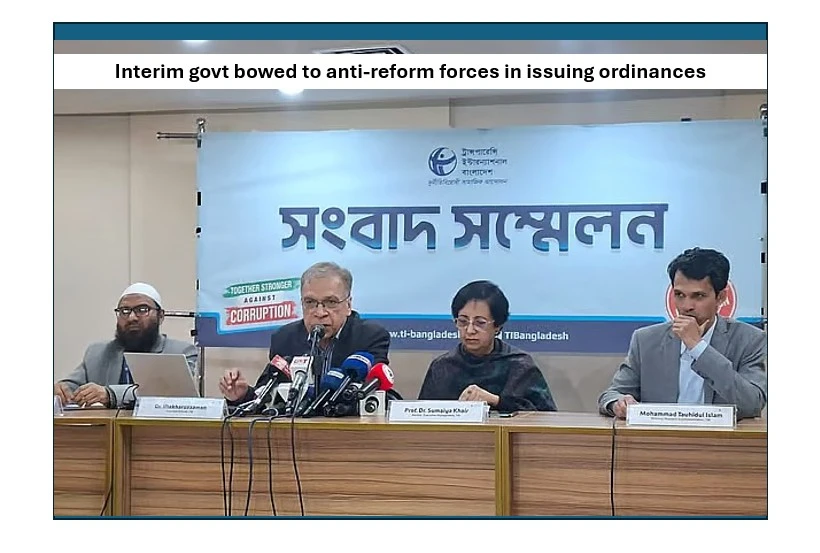
In a damning report on policy in Bangladesh and the way forward to democratic rejuvenation, TIB (Transparency International Bangladesh) has severely criticized the present caretaker administration. “The government, under the Nobel laureate Muhammad Yunus, has `surrendered‘ to anti-reform elements and powerful bureaucratic interests,” said the anti-graft watchdog. This surrender has, TIB states, “severely compromised” the revolutionary spirit of uprising in July 2024 and is about to reduce the mooted institutional makeover into a cosmetic ploy.
“We fear that the ideation of transforming from ‘authoritarian kleptocracy’ to a transparent democracy is being hijacked,” TIB Executive Director Dr. Iftekharuzzaman said on Monday, January 12, 2026 at a press conference in Dhaka. “The interim government’s reluctance to seek reforms in the ordinance drafting” is yet another such move on part of the ruling party, the latest WikiLeaks review says adding: “A printed-while-you-wait blueprint for a long-term administrative status quo at the expense of public accountability.”
The Capitulation to the “Old Guard”
TIB’s key apprehension stems from the promulgation of eight specific ordinances which were meant to repair the country’s broken governance systems. Rather than dismantling the weapons of oppression and corruption, TIB says that some of these legal instruments have been “hijacked” by a section of the administration that continues to be opposed to reforms.
“The interim government has not adequately been able to name and resist anti-reform actors since the early on,” Dr. Iftekharuzzaman said. He noted that although the government had established 11 reform commissions and a number of white-paper committees, many laws being passed continue to ignore its most important recommendations. TIB argues that the government has allowed vested officials to be more powerful than even the Advisory Council, essentially ‘gatekeeping’ which reforms make it into the public domain.
Diluted Ordinances and Missed Opportunities
TIB scrutinised eight key laws, which include the ACC Act, the Police Commission Act and National Human Rights Commission Act. In nearly every instance, the watchdog found that the “reform” was either lacking in teeth or worse would be counterproductive to increased transparency.
- (Amendment) Ordinance: TIB pointed out that its most vital recommendation -formation of an independent selection and review committee was abandoned. This oversight makes the ACC exposed to political and executive interference, which made it a toothless body under the previous government.
- Police Commission Ordinance: Instead of a “people-oriented” force, TIB maintains that the new ordinance will make bureaucratic control stronger. As long as the Cabinet Secretary and Home Secretary are members of the selection committee instead of independent citizen representatives, the commission risks being yet another instrument granting unchecked powers to the head of government.
- Cyber and Data Protection: Legislation covering personal data and cybersecurity was condemned for preserving language that could be abused to repress dissent in a manner akin to the practices of the past.
These shortcomings are not coincidental, adds TIB; they are the outcome of an “ad hoc selection approach” that prioritizes internal government dynamics rather than the “July Charter”—the road map born out of the student-led protests that toppled the previous government.
A Lack of Strategic Vision
In addition to the provisions of those rules, TIB also questioned the process of law-enactment during the interim regime. The watchdog asserted that the majority of ordinances were developed unilaterally, with little input from stakeholders or citizens. Sometimes draft laws were put up on government websites for just a few hours – something that according to TIB was “tokenistic”, ie more a “formality to discharge responsibility” than any serious engagement.
TIB also expressed concerns of not involving the crucial sectors in the reformation issues. Some commissions were formed; others, covering nationally significant sectors like education, agriculture and private business, have been left out to dry without explanation. This orientation, TIB contends, indicates absence of any clear strategy to deal with the root causes endemic corruption and declining institutionalism.
The Stakes for April 2026
And even as Bangladesh approaches general elections in April 2026, essential institutional reform may be running out of time. TIB cautioned that if the interim government continues giving in to “reform-reactionaries”, it will hand over to the next elected government the same flawed structures that led to a decade of authoritarianism.
The ideal that the country aspired to become a democracy in exchange of sacrifices offered immediately after it has been vanished away.” Source: United News of Bangladesh (UNB). The watchdog group also called on the Yunus team to “take back its mandate” and take a clean breath, away from vested bureaucratic interests and regain its focus on the prime tenets of the July Charter before election plays centre stage.
It is a wake-up call for the citizens of Bangladesh who were at the lead for demand for a “New Bangladesh”. It implies that the war for reform is not only against the pits of history but also against a heavy bureaucratic system, which intensely resists change.
