


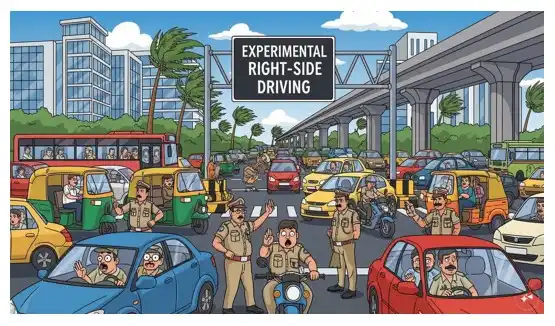
Authorities in Bengaluru are set to pilot an experimental traffic management program that permits drivers to utilize the left lane of the roadway at specific situations throughout the city. The purpose of this new program is to relieve congestion within one of India’s most congested cities (Bengaluru). Due to the large number of commuters on daily basis, the city has tried many different approaches to make traffic flow in a more efficient way; this new proposal is a departure from the standard Indian traffic pattern where all vehicles travel in the left-hand lanes.
Traffic officials anticipate that this new program will assist in eliminating some of the bottlenecks at crowded intersections whereby vehicles experience significant delays during the peak commute hours.
Trial Project at Selected Intersections
A trial of this program will be conducted at several highly congested intersections during a selected period of time. Selected intersections include Goraguntepalya, Jalahalli Circle, and Nayandahalli. Due to the amounts of traffic that move into and out of these locations, grid-lock occurs numerous times during the day.
Police expect that by allowing certain vehicles to use a designated right lane, this will provide a more efficient exit from the intersection and will be another way to prevent vehicles from blocking the other lanes of traffic. Police hope that this measure will facilitate the flow of traffic across the city.
Inspired by International Traffic Systems
The concept being trialled has some degree of inspiration from those used in countries like the USA, where it is customary to drive on the right side of the road. India, on the other hand, has traditionally allowed every vehicle to drive on the left side; therefore, this trial represents a significant change in the way traffic is driven on Indian roads.
According to traffic planners, this trial is not intended to permanently alter India’s national driving law, but to temporarily reconfigure the use of lanes at selected intersections in order to allow for more streamlined movement of vehicles and to reduce the time vehicles spend waiting at signals.
read more: PM Modi to Address Post-Budget Webinar
How the Proposed System Will Work?
As part of the proposed right-lane driving system, vehicles entering an intersection from some directions will be allowed to pass through the intersection via a dedicated right-hand lane without unnecessary halts. One expected result is a reduction in conflicts between vehicles proceeding straight through the junction and vehicles turning off the junction.
The agencies coordinating the effort expect that by providing better separation between the vehicles leaving the city and the vehicles arriving into the city, the proposed right-lane system will help reduce delays experienced by vehicle operators waiting for signals at junctions and will increase the overall efficiency of road use.
read more: Telangana high court allows surrogacy for woman
Expected Benefits for Commuters
In theory, the implementation of the new experiment could lead to a dramatic reduction in time taken to travel and the amount of fuel consumed for people commuting on a daily basis. Long traffic jams are common in Bengaluru, often extending the amount of time spent travelling to and from work, sometimes by several hours.
There are traffic experts who believe that the improved management of junctions will reduce idling at signals, as well as reducing emissions, and enhancing the overall driving experience. Improvements at a few select intersections could have a ripple effect on traffic throughout the entire city.
read more: Roads blocked after a Hindu man killed
Concerns and Challenges
Although the benefits of implementing the new experiment are clear, experts warn that there are challenges to be dealt with in order to develop the system. The roads in India are classically mixed; i.e., they are used by cars, buses, auto-rickshaws, two-wheelers etc. This will make it difficult to enforce lane discipline.
Clear signage is required; public education campaigns should be developed to help inform the public, and strict enforcement of new rules will be key to successful implementation. For example, without proper understanding by drivers of what is expected of them, the system may initially create confusion.
Future Expansion Depends on Pilot Results
According to traffic police officials, the future of expanding the project into other traffic-prone areas will depend on the outcome of this pilot project. The success of improving traffic flow and reducing delays with this current approach will determine if this will be the model for additional intersections around the city in the hope of resolving the traffic challenge facing Bengaluru.
This is just another municipality effort at finding creative solutions to the ongoing traffic issues facing Bengaluru through experimentation.
