


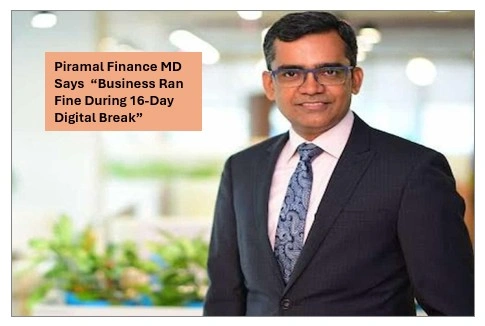
While it is common today to find that people are expected to be “always on” – an executive recently showed that taking a break from the constant connectivity can generate discussion about leadership & work/life balance as well as the myth of being “indispensable.”
V. Jairam Sridharan, CEO and Managing Director at Piramal Finance, took a 16-day digital detox from work, wherein he removed himself from all forms of communication (emails, phone calls, WhatsApp messages, social media, and news). Instead, he devoted this time to his family and friends without interruption. His reflections on LinkedIn resonated with professionals across the industry when he returned to work afterwards – many of whom were experiencing similar challenges.
Thousands of Messages Awaited His Return
Upon returning, Sridharan is said to have found thousands of messages awaiting him – over 3,000 WhatsApp messages, nearly 2,000 unread emails, and hundreds of missed calls were there for him upon arrival.
Some of the missed calls were from his manager and owner of the company – illustrating that business had continued during his absence. Although there was quite a bit of communication awaiting him, he stated that his biggest “aha” moment was not how much work was left, but rather that things had continued without him.
“My Absence Made No Difference”
Sridharan reflected on the situation to realize that while he had been away from his duties, business continued without interruption. The end-of-month processes were completed on schedule, the Reserve Bank of India had made some significant policy announcements, there were no changes in global or international events that required his input.
His conclusion was that, “all of the world has gone on without me.” This has become the basis for discussions regarding his digital-deleted experience.
Many business leaders and professionals feel that they are irreplaceable or unneeded by their organizations; however, according to Sridharan’s experiences, strong organizations can continue to operate effectively without the presence of senior management.
Must read:
- India restricts bulk sale of petrol and diesel at retail outlets for 90 days
- Assam’s Famous Tezpur Litchi Goes Global with First Export to Dubai
- Why did PM Modi ask Indian citizens to recycle gold?
Lessons in Leadership and Delegation
The management experts and other professionals who responded to Sridharan’s posting viewed his experiences as a general lesson for leadership. For example, several of the commenters stated that a well-functioning organization should not rely on the continuous presence of a key individual.
Having a CEO who is not working at all from a company during their absence reinforces the strength of company systems, processes and a strong bench of leaders; therefore effective leaders do not have to be involved in every operational detail but rather build high-performing teams that can function independently of their involvement.
A CEO’s Unusual Experiment in Disconnecting
Delegation and trust were key themes within the conversation. Leaders who empower their teams by providing them with decision-making authority create strong, resilient organizations which will operate effectively, even when they are not engaged.
The Value of Being Present
While going without digital technology for a couple of weeks did have some downsides, Sridharan felt that the rewards from being around family and friends without being distracted by any business-related issues would far outweigh any negative consequences.
Many professionals who find it difficult to set boundaries in a highly connected work environment, can possibly relate to the insights provided by Sridharan’s comments around disrupting the balance between work and life through technology. Examples of technology disrupting the work-life boundary are smartphones, instant message platforms and remote working tools that have blurred lines, and thus create an expectation of always being available to work, whenever required.
Sridharan’s experience will continue to remind professionals of the potential value gained in their lives when they are able to take a break and gain perspective on things besides work.
A Growing Conversation on Workplace Culture
As conversations about burnout at work, well-being and having a sustainable place to work continue to gain traction in all fields, more and more businesses have begun encouraging their staff members to take breaks from work, take time off and set boundaries with technology.
Even though senior leaders typically do not take all of their vacation time each year, Sridharan’s decision to completely disconnect for 16 days shows that it is possible for senior leaders of large organizations to take time to disconnect completely from their jobs.
Bottom line
The larger lesson Sridharan learned while he was away is that while we as leaders are important players within an organization, the success of an organization does not come from one person, but instead from how an organization is designed to last beyond any one individual. To ensure continuity and allow themselves the opportunity to recharge after long periods of working, leaders must trust their teams and develop strong systems for supporting their continued growth.
Ultimately, when he returned, Sridharan realised through his own experience that the world continues on a daily basis, businesses continue to operate on a daily basis, and sometimes the biggest lessons come from stepping back and learning that things will function as if they don’t need our involvement.
