


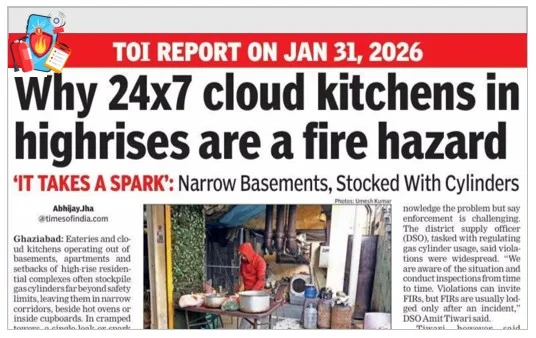
When you order a steaming bowl of biryani, or a late-night burger, via an app for delivery, the architectural safety of the building it’s cooked in is the last thing on your mind. You want a kitchen and a cook, and you want something that’s clean for health reasons. However, a shocking new survey by the Ghaziabad Fire Department has shone a spotlight on a dangerous reality: there are now dozens of “ticking time bombs” in the city disguised as virtual eateries.
According to a recent in-depth safety audit conducted by the fire brigade, of 62 cloud kitchens audited citywide, only five are currently holding valid Fire NOCs. The other 57 are working in dark cellars of high-rises and residential flats, hoarding explosive LPG cylinders in spaces never meant to be commercial cooking venues.
The Danger Zone: The Anatomy of a “Ghost Kitchen”
Restaurants exist only on apps like Swiggy and Zomato, with no dine-in space — were considered a game–changer for small entrepreneurs. But in Ghaziabad, this transformation has gone dangerously off the rails.
Conducted in response to a series of investigative reports and intensifying protests by residents, the survey found that these kitchens are not just in commercial hubs. They have reached the innermost recesses and the basements of high-rises, so called “setback” (emergency exit) zones in hughly crowded societies.
Where the Risk Clusters
Indirapuram Zone: The epicenter of the mess, hosting 28 functioning cloud kitchens. Of these, 12 were operational from one society alone -Jaipuria Sunrise Greens in Ahinsa Khand 1.
Kavinagar Zone : cloud kitchens
You have about half a dozen kitchens each in Sahibabad and Shalimar Garden.
Hidden Locations: Kitchens were found on the second and third floors of residential towers, far from easily accessible fire tender access.
The “Cylinder Siege”: A Disaster in the Making
The most disconcerting part of the Fire Department’s survey was not just the absence of paperwork — it was how much fuel was being warehoused. Under regular safety rules, a hotel can stock just two LPG cylinders.
In the basements of Ghaziabad, it’s another story. Inspectors discovered that in nearly every cloud kitchen visited, they had at least two cylinders while some were hoarding as many as eight to twelve such cylinders on a single premises. They are sometimes stashed in cramped corridors, next to sizzling industrial ovens or even inside wooden cabinets to keep them out of view.
The Physics of an Explosion
An LPG cylinder explosion in the basement can weaken the building up to M+2 storeys. And when you’re dealing with a “cluster” of 12 kitchens in your basement any one leak sets off a chain reaction. The 2019 explosion at Jaipuria Sunrise Greens, where a fire in a basement kitchen led to multiple blasts burning for more than five hours and requiring a dozen fire tenders to douse, is fresh in residents’ memories. The 2026 survey is proof that, despite that near-tragedy, the lessons are still unlearned.
