


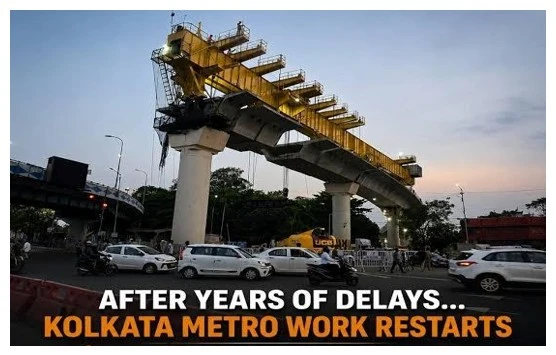
15 years after being postponed due to multiple reasons, Associated Press reports that the necessary approvals were granted and the Orange Line Metro Rail Extension at Chingrighata has now been constructed in 15 days. Completion of this segment is creating renewed discourse around stalled infrastructural projects in West Bengal and surrounding issues of governance.
The segment of the Orange Line at Chingrighata consists of launching girders over the 366-meter span to connect the Orange Line from New Garia to Netaji Subhas Chandra Bose International Airport via Sector V (the IT Hub of Kolkata).
Missing Link Finally Connected
Chingrighata was the largest choke point in the Orange Line project. As the executing agency, Rail Vikas Nigam Ltd. was to have restricted traffic flow for two consecutive weekends to mount the concrete girders above the busy and congested intersection. It is alleged that permission for that has been pending for almost two years.
Overall, the Orange Line was to be a key component of the overall expansion project of Kolkata Metro. Originally, the 32-kilometer project was to have been completed between 2016 and 2017, but was stalled by numerous issues involving land acquisition, lack of agreement among agencies on traffic diversions, and bureaucratic deadlocks.
Once authorization was obtained to continue with construction, engineers completed the necessary work over a period of two weekends resulting in the completion of the most urgent phase of the project within approximately 15 days from the time that construction began. The rapid completion of this section of the project has generated considerable interest due to the contrast between the years that it took to obtain permission to commence construction and how quickly work progressed after obstacles were removed.
read also: What Is Nepal’s Romeo and Juliet Clause in Rape Law?
BJP Leader Attacks Previous Government
Amit Malviya who is a BJP Leader claimed that the long delay for construction on this project was due to the previous government under TMC’s leadership. According to him, what was to take 15 years to launch and complete was accomplished in 15 days once the political hurdles were removed.
Malviya stated that repeated denials from the TMC to allow traffic diversions were the primary reason for the continued delays. Once “political impediments” were eliminated he stated that work on this project progressed quickly.
As of now, no detailed formal response has been made by the TMC concerning the comments made by Malviya. However, prior to these comments made by Malviya, TMC had cited traffic management and public inconvenience for the closure of one of the busiest intersections in Kolkata as reasons for the delays.
read also: West Bengal Transfers 120 Acres of Land to the Centre
Court Intervention Played Key Role
The problem had also been established in court. Reports have indicated that the Calcutta High Court had previously asked all parties-including Metro Railway, RVNL, Kolkata Police, and the state government-to get together and find a solution to the impasse. Subsequently, it is reported that the Supreme Court dismissed the state government objections and removed the obstacles to complete construction of the project.
Following the intervention by the courts, construction that had been delayed was being completed once again, with speed.
read also: BJP changes street colors post its victory in West Bengal
Benefits for Urban Connectivity of Kolkata
The completion of the Chingrighata section of the Orange Line will greatly enhance the connectivity of the southern suburbs of Kolkata to Salt Lake Sector V and the Airport Corridor. Once the entire Orange Line is operational, daily commuters travelling from all parts of Kolkata to Salt Lake Sector V, primarily the IT sector, would greatly benefit.
According to transportation experts, the corridor has the potential to shorten travel times significantly as well as relieve pressure on important roads such as the EM Bypass and VIP Road. Additionally, it is anticipated that this metro line will help promote economic development in eastern Kolkata which continues to see rapid growth.
Symbol of Fast-Track Infrastructure?
Now, the rapid completion of the project has become a hot topic among politicians and citizens across Bengal. The current ruling party is using this example to argue that if the blockages of bureaucracy could be eliminated, large public works such as transportation projects could be finished much earlier than they would otherwise have been.
Conversely, a number of critics maintain that the length of time any important public transportation project would have taken to complete should not have resulted in so much delay.
For the residents of Kolkata who have now waited for more than ten years for improved public transportation (i.e., through metro rail), the focus now needs to be on the final completion of the project and when all parts of the entire Orange line corridor will open.
