


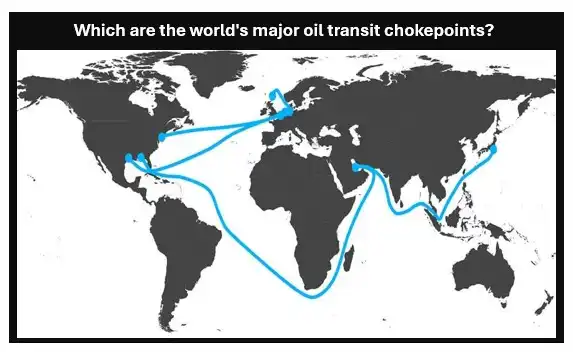
Global energy supply chains, primarily reliant on oil and oil-products from maritime vessels, are subject to extreme volatility and risk of supply disruptions due to blockage or disruption of oil transport facilities. Therefore, oil choke points—narrow sea transport routes that oil must use to access global markets—are extremely critical to the stability of both energy and the global economy. According to the U.S. Energy Information Administration, the maritime oil trade of approximately 80 million bpd flows through major sea choke points on their way to end users.
The following choke points are the main global maritime transport choke points for oil, including their criticality to the supply of crude and refined products to feed the world’s growing energy demand.
- Strait of Hormuz: The Single Most Important Oil Choke Point
The strait of Hormuz, located between Iran and Oman, has been the world’s most critical oil choke point since long before the United States invaded Iraq in 2003. The strait connects the Persian Gulf to the Gulf of Oman and the Indian Ocean, making it the primary export corridor for oil produced in the Persian Gulf by Gulf nation such as Saudi Arabia, Iraq, Kuwait, and the United Arab Emirates.
Approximately 20.9 million barrel per day (bpd) (about 20% of global oil consumption and approximately one-quarter of the world’s maritime oil trade) transited the strait of Hormuz in the first six months of 2025.
Due to its narrow width, the strait is susceptible to geopolitics of competition. Recent regional disputes, and threats of disruption, have brought to light the critical nature of the strait’s importance to the entire world; blockading the strait would immediately result in increased energy prices and interrupted supply chains.
- The strait of Malacca(southern) is an essential link for all of Asia’s energy needs
The strait of Malacca (south) is located between Indonesia, Malaysia and Singapore, connecting the Indian Ocean to the South China Sea and the Pacific Ocean, and serves as Asia’s largest oil transit chokepoint, accounting for approximately 29 percent of global seaborne oil flows, or 23.2 million bbl/d. This strait represents the shortest maritime route connecting Middle Eastern oil producers to major East Asian energy importers including China, Japan, and South Korea. The strait is a heavily trafficked, narrow waterway that exposes the oil trade route to risk from accidents, piracy, and geopolitical concerns.
- The Bab el-Mandeb strait serves as the gateway to the Suez trade route
The Bab el-Mandeb strait runs between Yemen on the Arabian Peninsula and Djibouti and Eritrea in the Horn of Africa. It is a passageway for oil and petroleum products from the Indian Ocean and Red Sea to the Gulf of Aden, and approximately 4.2 million bbl/d pass through this chokepoint.
The Suez Canal, along with SUMED (Suez-Mediterranean) Pipeline in Egypt, provides a key oil transit chokepoint for tankers moving from the Red Sea to the Mediterranean Sea. This allows for the shortest marine link between Europe and Asia, and the combined oil transport capacity of both the Suez Canal and the SUMED Pipeline is approximately 4.9 million barrels per day.
The Suez Canal serves as the most direct means of transporting oil from the Persian Gulf to Europe; however, blockage or disruptions along the canal would create substantial excess travel on the route from the Persian Gulf to Europe (i.e., the vessels would have to go around Southern Africa via the Cape of Good Hope).
- Turkish Straits (Bosporus and Dardanelles): Oil Trade Between Black Sea and Mediterranean Regions
The Turkish Straits (Bosporus and Dardanelles) connect the Black Sea with the Mediterranean and handle around 3.7 million b/d of oil, primarily from Russia and other producers in the Caspian. Shipping through the Straits is highly congested due to the large concentration of people that live in or near Istanbul.
- Danish Straits: Baltic Oil Gateway
The Danish Straits are found between Denmark and Sweden and they connect the Baltics to the North Seas. There is an average of about 4.9 million b/d of oil moving through these passages.
These straits are an important way for crude oil and refined products from ports located in the Baltics, mostly connected to Russian oil, to be exported.
- Panama Canal: Strategic Inter-Ocean Route
The Panama Canal connects the Atlantic and Pacific Oceans and provides ships the opportunity to save some time on their journey to travel around South America. Although it is a very small amount of oil that goes through this canal (about 2.3 million b/d), it still provides a very strategic route for energy shipments from countries in the Americas to countries in Asia.
However, because of the size of the canal, there are limits on the amount of very large crude carriers that can pass through it.
read also:
- Harsh Goenka suggests alternative route post Strait of Hormuz closure
- Modi Talks With Iran’s President as Tankers Stall in Hormuz
- LPG Cylinder Selling For Rs 6,500, Refill For Rs 4,000
Conclusion
The key locations in the worldwide energy supply chain for oil are called transit chokepoints. These include the Strait of Hormuz, Strait of Malacca, Bab el-Mandeb Straits, Suez Canal, Turkish Straits, Danish Straits and Panama Canal, all of which globally transport a great deal of the oceans’ oil. Geopolitical issues, military conflicts or an accident at one of these areas could lead to an immediate consequence on all parts of the globe – either through the impact such issues have on the security of energy supply or on the price at which these prices can be obtained.
With the increase in the global energy demand, the assurance of energy supply by security and stability in these oceanic chokepoints will continue to be a concern for the shipping industry, government agencies and the global energy market as well.
