


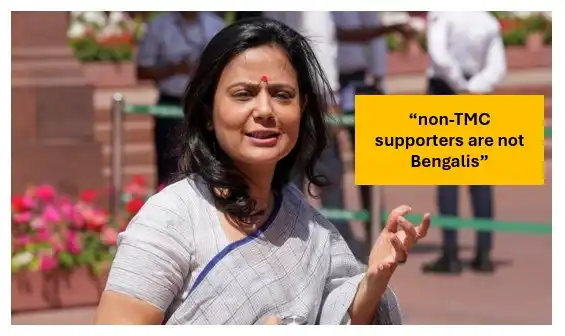
A political firestorm has been ignited since Mahua Moitra (MP, All India TMC) allegedly indicated that those who do not support TMC cannot be referred to as “Bengali.” The comment was made during a mass protest in Kolkata, and has since received a significant amount of backlash by opposition leaders.
The remarks were made while Moitra spoke before her supporters at a protest being held at Dharmatala, Kolkata. The concern around the protest was related to the issue of Special Intensive Revision (SIR) of electoral rolls. Moitra asserted during her speech that all those who did not support TMC were not “Bengali” and had no right to reside in Bengal, as Chief Minister Mamata Banerjee is fighting only for them.
The extent to which Moitra’s comments circulated through social media only added to the heightened feelings of political unrest in West Bengal.
The relevant political framework for the above statement is one of heightened confusion, division and uncertainty as it relates to political factors surrounding the upcoming assembly elections in West Bengal. Over much of the past year, identity politics have dominated political discussions in West Bengal with respect to both citizenship and voter roll debates.
The TMC has begun mobilising supporters for opposition to the alleged irregularities concerning revisions of electoral rolls, and with opposition parties claiming the ruling party is attempting to create a split amongst voters in a way that is divisible by their region of origin or by their language.
The Leaders of the Opposition Criticise the Comment
The Bharatiya Janata Party (BJP) and other opposition parties have vociferously condemned the comments made by Moitra. Spokesperson for the BJP, Shehzad Poonawalla described the comment as “intolerant” and the TMC as acting out of a “dictatorial mindset”.
Political affiliation does not define who someone is culturally or ethnically, according to opposition leaders. Some critics were also concerned that this statement implies that individuals who oppose the ruling party are denying their identity as a Bengali, which violates the democratic principle that all identities are legitimate.
read also:
- Iran Names Mojtaba Khamenei as New Supreme Leader
- Petrol Bomb in Pakistan Fuel Prices Jump by PKR 55
- LPG Price Hike Sparks Concern
Controversy about Regional Culture and Political Identity
The discussion over political loyalty versus regional identity in the state of West Bengal has incited further debate surrounding this issue. Many critics believe that making an equal relationship between one’s political party support and one’s cultural identity may deepen political divides in the state.
The TMC supporters argue that the comment addresses the frustration they have experienced from what they view to be an assault on both their political sovereignty and their cultural identity as a people of Bengal.
Growing Political Row
As this debate continues to be in the spotlight, this will continue to cause conflict and be a determining factor leading into state elections. According to political analysts, this comment made by would lead to further division between TMC and its competitors.
This incident reflects the continuing importance of both Identity Politics and Regional Pride in the political culture of the state.
