


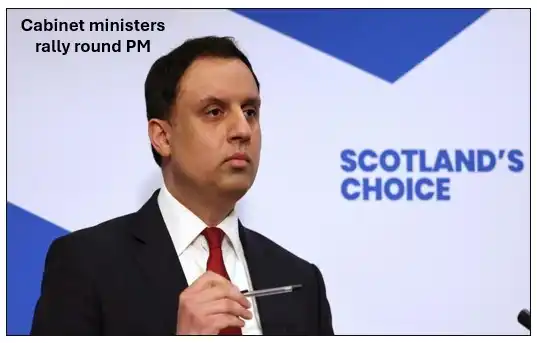
The corridors of power in Westminster and Holyrood are shaking this week with a tension that, while familiar, feels peculiarly raw. Hours after the party’s bitter local election results became clear, and following a series of policy shifts in recent weeks, Sarwar broke from Sturgeon on Saturday — in what was for many observers an announcement that seemed inevitable. By calling publicly for the Prime Minster to resign, Sarwar has done more than fire a warning shot; he seems to have launched a grenade into the middle of the present occupant of Downing Street.
But the fracturing of the front bench that Trudeau critics expected is instead being met with a united show of loyalty on the part of the Prime Minister’s inner circle. This “rallying of the troops” indicates a government digging in for a long winter of political attrition, despite shifting moods among Australians.
The Sarwar Intervention: A Gamble It is a risky move, the intervention of unheralded Jawed H Sarwar late Wednesday night.
Anas Sarwar’s demand for a change in leadership was not just an angry outburst, born of heat and stress. It was a cold-blooded and deliberate one, intended to insulate the Scottish wing of the party from what is seen as the “toxicity” surrounding recent decisions by central government. Right now, Sarwar, who has been given the credit for Labour’s recovery north of the border, is walking a tightrope. To win in Scotland, he needs to look independent, strong and responsive to a Scottish electorate that frequently feels ignored by London.
His case rests upon “moral authority.” “The leadership are now a lightning rod for disillusionment and making it hard to get our message to voters.” Sarwar believes that the party is hampered in getting across its core arguments. And he is appealing to the grassroots by calling for the PM’s resignation—he wants to be their voice, the man prepared to articulate what “they” are saying only quietly in the tea rooms of the house.
Public Perception: It’s a Toss Up
Away from the televised debates and the meticulously worded press releases, it is a process that has left members of the British public looking on with a combination of fatigue and frustration. To the ordinary voter, a Cabinet “rallying round” generally appears less like principled loyalty and more like a collection of people all desperate not to lose their jobs.
The price in human terms of this political theater is high. If a government is concentrated on its own internal survival, the business of day-to-day governing — fixing the NHS, tackling the cost of living and raising standards in education — can seem like something that can wait. The risk for the Prime Minister is that “stay the course” begins to look like “stall,” and “unity” begin to look a lot like “denial.
You may also like:
- Hindu identity is a cultural and civilizational umbrella
- Govt Deactivates Over 2.5 Crore Aadhaar Numbers
- EAM Jaishankar Highlights Need for Global Cooperation
- Tarun Chugh appointed as BJP’s central
What Happens Next?
Politics is seldom shaped by a single speech or a single call to give it up. It is a game of momentum. If other regional leaders follow Sarwar, the Cabinet will come under irresistible pressure. For the moment, the PM has numbers and he also claims the backing of his most senior ministers.
But the “Sarwar Moment” is a change from all that. It has punctured the image of a completely unified party and given license to other dissidents to speak up. The next few weeks will be a test of the PM’s strength and his ability to reconnect with an increasingly disaffected public, tired of the parochial ways of Westminster.
The Cabinet might be circling the wagons today, but in politics anything can change and today’s “unwavering support” is always tomorrow’s “regrettable resignation.” It’s not just his policy agenda he is fighting for any more; it’s the soul of his leadership.
