


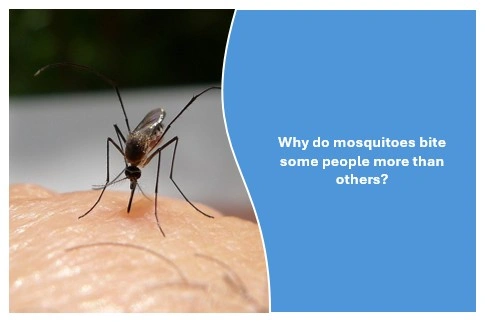
Many individuals recognize that mosquitoes have preferred feeding habits and different individuals may experience a dramatically different amount of mosquito bites in a similar environment (i.e., multiple individuals standing together). This is not pure happenstance, as there are a variety of reasons (biological/chemical/environmental) for this phenomenon.
How do mosquitoes “find” their victims?
Female mosquitoes are biologically determined to consume blood in order to lay eggs, and when searching for a victim they rely on specialized sensory organs that guides them towards a potential source of blood. Female mosquitoes are attracted to the carbon dioxide, heat, and scent of the skin and other odors emitted from a person’s body.
Carbon dioxide can be detected by mosquitoes from several meters away and as they approach the potential victim further, they will utilize body heat and scent in order to determine which one they will bite. Based upon very small differences that exist between people, some people will have a greater attraction to mosquitoes than will some others.
The Role of Body Odor
The body odor of humans has a significant impact on how mosquitoes make their choices. The bacteria present on human skin help to colonize the bacteria present on it as well as breakdown sweat and create what is known as volatiles (scent) that will be released into the environment. These volatiles come from each person’s own individual skin microbes and, despite similar amounts of sweat, two persons can produce entirely different volatile compounds, which will perpetuate the differentiation of their attractiveness to mosquitoes amongst the two individuals.
Research has shown that mosquitoes are particularly drawn to certain compounds that are produced by the thermal, aerobiological, and biological decomposition of microbes present on human skin (e.g., lactic acid, ammonia, carboxylic acids), and, therefore, an individual that produces a higher concentration of these compounds would generally attract more mosquitoes than another individual.
If two individuals sweat equally in mass and the same microbacteria are present but create dissimilar odors from the metabolic action of decomposing the sweat, then that can make one individual more (or less) attractive to mosquitoes than the other individual based on the specific volatile compounds created from the skin bacteria of the two individuals.
You may also like:
- 7 Morning Routines You Should Never Skip According to Experts
- What Is the 5-Finger Breathing Technique? What Are Its Benefits?
- Neurologists say brain tumor signs that often get unnoticed
Carbon Dioxide
When humans breathe, they produce carbon dioxide (CO₂); thus, all humans are generally emitting CO₂ every time they breathe. Since mosquitoes are very sensitive to CO₂, the amount of CO₂ produced through respiration (e.g., exhaling), particularly in individuals producing more CO₂, would generally result in attracting more mosquitoes.
Several factors influence carbon dioxide production:
- Larger body size
- Higher metabolic rate
- Physical activity
- Pregnancy
Older adults typically draw in more mosquitos than younger kids do. This is because older people breathe out more carbon dioxide than young kids do. Another group of people who are more likely to be bitten by mosquitos are people who are sweaty and out of breath after exercising. Because their bodies are working harder, they have a higher body temperature and are breathing at a faster rate.
Mosquitos tend to want to be near something that is warm. The body is always giving off warmth, and mosquitos have sensors that pick up that warmth.
Mosquitos may find people with a higher than average skin temperature to be very appealing and, as a result, may bite them. If a person is sweating from physical exercise or situational heat, has a fever, or has a medical condition that causes his or her body temperature to be above average, then they are easier to find.
Another reason mosquitos could bite someone is that the mosquitos are able to find them based on how warm some of the body is. The mosquito typically feeds on the blood in the area of the body that have a lot of blood vessels near the surface. For example, a person may be bitten on the forehead, neck, wrist or ankle by mosquitoes.
Why Pregnant Women Get More Bites?
Pregnant women often report increased mosquito bites, and scientific studies support this observation.
During pregnancy:
- Carbon dioxide output increases.
- Body temperature rises slightly.
- Blood flow near the skin surface may increase.
The amount of light absorbed is linked to the darkness and contrast of an object. For example, wearing light-colored clothing reduces a person’s attraction to mosquitoes, especially during daylight hours. Therefore, people wearing all, or mostly, black clothing or dark blue or red will usually appear to mosquito eyes as being more easily identified than those wearing white or off-white clothing. Thus, mosquitoes will more easily identify a person in dark clothing than in light clothing.
While mosquitoes can see color, they do so largely (if not entirely) through their ability to perceive changes in the brightness and, possibly, temperature of the objects surrounding them. The following are ways that mosquitoes use sight, by disrupting the brightness and contrast of a person’s clothing:
- Skin chemistry
- Sweat production
- Composition of body scent
- Body temperature
Mosquitoes use the four factors in order to determine if a potential host will provide them with a suitable source of blood. Consequently, mosquitoes will “target” people based on their skin chemistry, sweat, scent, and temperature, thus increasing the likelihood of biting a person who is strongly attracted to mosquitoes.
Scent, one of the four factors above, may also provide insight into why people have different levels of attraction to mosquitoes and why there are genetic differences in mosquito attraction.
Alcohol Consumption and Diet
Some studies provide evidence that alcohol (especially beer) consumption may increase the level of attraction to mosquitoes. While researchers have not yet identified which factors are responsible for the increased attraction a variety of possible explanations exist ranging from increased metabolic activity, heat produced from the body, or changes in skin chemistry may all play a role.
It is also believed that diet can affect body odor and sweat makeup. However, there is little support in the scientific literature for the claim that eating garlic or taking vitamin B-12 supplements or other specific foods will completely eliminate the likelihood of being bitten by mosquitoes.
Environmental Factors
It is widely believed that the level of attraction a person has to a mosquito can be affected by the environmental conditions surrounding them.
Some of the factors that will increase the amount of activity from mosquitoes:
- Temperature/Warmth
- Humidity
- Proximity to Standing Water
- Time of Day (Dawn or Dusk)
If a person is standing close to where mosquitoes breed or resting areas, regardless of their biological make-up they will be more likely to be bitten.
Conclusion
Mosquitoes bite different people at different rates because they have a variety of factors that they use to decide whether they will bite a person or not; this includes the body chemistry/scent, amount of carbon dioxide produced by the person, amount of body heat generated, genetic make-up of the individual, blood type, a female mosquito who is pregnant, and clothing style worn by the individual.
