


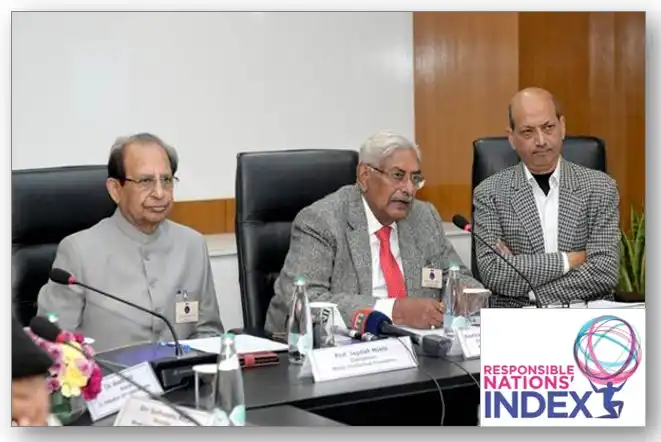
In a period when international leadership tends to be determined by size of a country’s military or the power of its stock markets, a new measuring stick may soon come into play around the globe. On January 19, 2026, beginning with its full launch of the Responsible Nations Index (RNI), today’s unrivaled global value metric that rethinks what it means to be a “successful” nation in the 21st century.
Cause of Worl d the launch event Verges on the unconventional geopolitical rankings. Conceptualised academically in association with Jawaharlal Nehru University (JNU) and authenticated by the Indian Institute of Management (IIM), Mumbai, RNI is aimed to completely change/remove/replace the global discourse from “which are the powerful nations?” to “which nations act responsibly?”
An Overhaul of World Data(EXIT)
The yardstick of national progress for decades has been the Gross Domestic Product (GDP). But increasingly, policymakers and ethicists have made the case that gross domestic product (GDP) growth alone doesn’t measure up to a country’s moral and ecological footprint. The RNI seeks to bridge this “ethical gap” by evaluating how 154 nations wield their power toward their own citizens, the world at large and the planet.
“To make ‘ethics, sustainability and cooperation’ the lynchpin of global evaluation, RNI wants to revolutionise the definition of progress,” said Sudhanshu Mittal, Secretary World Intellectual Forum in a statement at a press conference.
The index departs from static indicators like military spending or trade volume, and tries to quantify “stewardship” — the idea that nations exercise power as stewards for future generations.
New Zootopia Shimmer Wishables Plush Now Available at Disneyland
The structure of responsibility: Three basic dimensions
As the above suggests, the RNI is not some abstract philosophical gesture but a concrete scholarly framework that consists of seven dimensions, 15 aspects, and 58 indicators. Such indicators come from expendable, publicly available datasets globally, which make the rankings credible and comparable.
The following three fundamental pillars are the structure of the index: 1.
- Structural Responsibility: This scale measures how well a country is taking care of its own population. It includes elements like dignity, social justice, and the preservation of basic freedoms.
- Environmental responsibility: More than any other issue, the climate crisis is shaping history, so this pillar assesses a country’s sustainability and proactive measures toward climate action.
- External Responsibility: This gauges the nation’s behaviour in global contexts, and it’s respect for international law, as well as the joining of multilateral efforts.
India Post Launches Speed Post 24 and Speed Post 48 Services
Timing and Geopolitical Relevance
The timing of the launch is especially poignant. Given that 2026 will be a year of major regional conflicts and increasing climate anxiety, the WIF argues that the world is in need of a “moral mirror.”
Speaking on the occasion, Prof. Jagdish Mukhi, Chairperson World Intellectual Foundation and ex-Governor of Assam & Nagaland said: The index seeks to be a dynamic instrument. “This index is not static. We will update it every year, based on how all nations perform at a global level,” Mukhi added.
The foundation believes that “the RNI isn’t about ‘naming and shaming,’ but policy learning.” But by spotlighting what nations do well in “responsible conduct,” the WIF hopes to help create a virtuous cycle for ethical governance, akin to technology’s Global Innovation Index.
Toward a New Global Dialogue
The January 19 launch is likely to lead to a heated international discussion. Unlike other similar indices that become extinct in a short period of time, this is the first outing from the Global South, comprehensive in scope and profound in academic backing; it questions Western models of “good governance.”
The WIF is, in effect, creating a new diplomacy jargon in the sense that this scientific “method” makes “responsibility” tangible. In a “world of guided missiles and misguided leaders” as the foundation’s founder Dr. Rajendra Pratap Gupta often refers to, the Responsible Nations Index is a roadmap towards a more peaceful and sustainable future.
The first full report, whose format it is hoped will be repeated annually in March, offers a kind of climate action checkup for the world’s moral health each year. The message the delegates are gathering in New Delhi next week is simple: powerful is not good enough, anymore, in the world order of 2026 — one also has to be responsible.
