


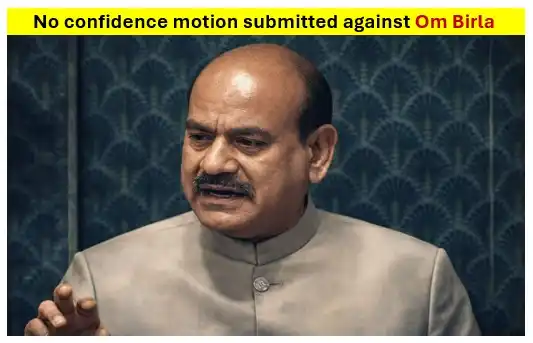
On Tuesday, February 10, 2026, the Indian Parliament’s opposition presented a detailed, written no-confidence motion urging for Lok Sabha Speaker Om Birla to be dismissed from his position as a Member of Parliament. This was done through an official notice submitted to Utpal Kumar Singh, Secretary-General of Lok Sabha, under the provisions of Article 94(c) of the Constitution/Rule 94C of the Lok Sabha rules carrying the signatures of approximately 118 -120 Opposition Members.
According to Gaurav Gogoi, Congress Member of Parliament and Deputy Leader of the Party in Lok Sabha, the basis for submitting this notice was the alleged “blatant partisan behaviour” of the Speaker in his role, that he has done great harm to the democratic functioning of the House.
Why did the opposition take this step?
Opposition leaders & Parties have also raised their concern regarding Speaker Birla by citing examples of procedural chaos in Lok Sabha, the suspension of 8 Opposition Members of Parliament and that he has been favouring the ruling party during this current year’s budget session. Opposition members including Rahul Gandhi, the Leader of the Opposition, are reportedly complaining that they were not provided with adequate opportunity to address their grievances to Speaker Birla during the Motion of Thanks for the President’s address.
There was some uncertainty about how individual members or parties from within the INDIA Bloc would vote on this no-confidence motion. For example, TMC did not give their written grievances to the Lok Sabha Secretary-General before signing the motion at its submission.
Om Birla has ordered members of the Lok Sabha Secretariat, after receiving receipt of these documents, to review, and expeditiously conduct all further procedures according to the Parliamentary rules, within hours of receipt of the Notice.
Instead of presiding over the Lok Sabha as per normal when a dismissal motion against him for Speaker is pending; Om Birla will not preside at the Lok Sabha until the no-confidence motion is decided.
Next Steps – Process and Timeline
The process for introducing a Parliamentary procedure mandates that any submission of no-confidence against the Speaker, will require discussion and an eventual vote from the Lok Sabha. It is anticipated that a discussion on this no-confidence motion will likely occur on or about March 9, 2026, as part of the second seating for discussion of the 2026 Budget in the Lok Sabha.
The Lok Sabha Secretary has discovered a number of procedural errors in the notice sent by Om Birla including incorrect dates listed on the notice as this has the potential to render the notice unserviceable should they be rectified. Additionally, as per instructions from Om Birla, the notice must also have all corrections made before it can be submitted to Lok Sabha as for discussion.
Political Climate – Increasing tensions in Parliament
During the time period in which this no-confidence motion is being introduced, many tensions are escalating in Parliament due to the increasing frequency of disturbances occurring during sessions of Lok Sabha and extreme differences of opinion on the manner in which Parliament should be run by both the BJP-NDA ruling coalition and the INDIA opposition coalition.
Many opposition leaders feel they have generally not been given their right to present their issues for consideration by the House, as the BJP contagently accuses opposition Members of Parliament (MP’s) of provoking disturbances in Parliament.
There is also the indication from Congress sources that Rahul Gandhi’s absence as a co-signatory to the notice was tactical; no clear reasons have been released as to why he chose not to sign the Notice of Motion.
The Passing of the Motion’s Significance
In the extremely rare circumstance that the motion were to pass by a majority of the sitting members of the Lok Sabha, it would remove the Speaker of the Lok Sabha. This would be an extraordinarily serious situation in Parliament and could illustrate the highly acerbic political competition evident in the 2026 Budget Session.
However, given that the ruling party has an overwhelming majority in the Lok Sabha, opposition to the ruling party will not be able to muster the votes to carry the motion; therefore, the motions will be seen as being a result of continuing conflict and distrust between the parties in regard to adherence to Parliament’s norms as opposed to both political and parliamentary disagreements, and the nature of these motions will be viewed as much more symbolic than practical.
