


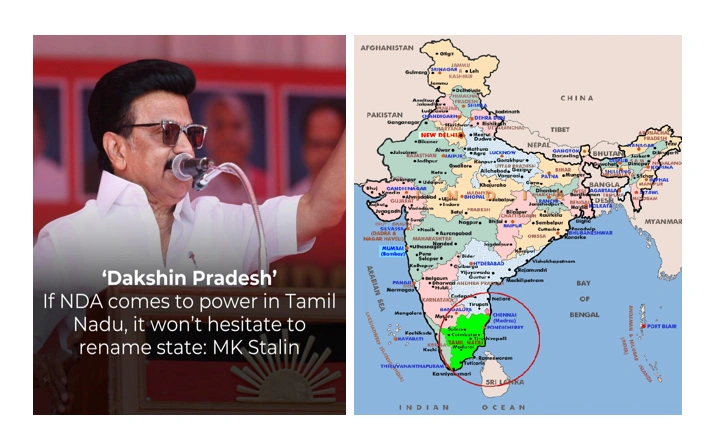
The NDA has brought a new political issue to the fore with reports that it is exploring the option of renaming Tamil Nadu (the southern state) as “Dakshina Pradesh”. This proposal has not yet reached the proposal stage, but it is already getting strong reactions from all parties (political), all cultures (linguistically), and civil society (in every way).
Historically, Tamil Nadu was named Madras State, until it was officially changed to Tamil Nadu in 1969. The name Tamil Nadu means “Land of the Tamils”, and changing this name would be an affront to the Tamil people as it is linked closely to identity, federalism and the pride they have in their region.
Significance of Dakshina Pradesh
The term Dakshina Pradesh is derived from the word Dakshina which means “south” in Sanskrit, and Pradesh which means “province” or “state”. Proponents in the NDA believe that the name will give Tamil Nadu a more inclusive geographic identity and also conform more closely to the naming conventions for the rest of the nation.
Additionally, supporters believe that by using the name Dakshina Pradesh it will symbolically bring Tamil Nadu into the Indian cultural framework. However, opponents believe that by changing the name to Dakshina Pradesh, it dilutes the identity associated with being Tamil.
Read also: PM Modi to address first NDA election meeting in Madurantakam
Political Reactions Intensify
There have been robust and opposing responses from both sides regarding the political response in the state. Many of the main regional parties have rejected the proposal, particularly those with Dravidian roots. Significant political figures from the two most prominent parties—the Dravida Munnetra Kazhagam (DMK) and the All India Anna Dravida Munnetra Kazhagam (AIADMK)—have berated the new name, saying that it is redundant and disrespectful.
According to these leaders, the name Tamil Nadu has great significance beyond just being an administrative designation; it represents centuries worth of pride in language and literature and has colourfully evolved over time in terms of cultural identity. To people opposing the proposal, this proposal has been framed as a way to coerce people into a homogenized identity whereas previously, they had recognized and expressed their distinct cultural-identifications.
Conversely, some members of the National Democratic Alliance (NDA), which includes all of the regional parties of India and is dominated by members from the Bharatiya Janata Party (BJP), has urged the public to view the proposal as being a part of an open-ended dialogue rather than a predetermined decision. Members of the NDA are very clear in their messaging: Whatever the outcome, there will be a significant amount of consultation, and any change to the name must go through a formal process in accordance with the constitution.
Cultural and Linguistic Issues
Throughout history, the issue of language has been one of the most contentious issues in Tamil Nadu, and the state has a long-standing history of opposing the perceived imposition of Hindi and North Indian cultural norms. The 20th-century anti-Hindi movements have been a major influence on the political opinions of many residents of Tamil Nadu.
Some people believe that changing the name of the state will bring back tension from prior conflicts. Tamil has a long history of literature with many examples dating back two-thousand years. The term “Tamil Nadu” honors that literary tradition.
Some people are concerned that using a Hindi-like alternative name would deny the state of the uniqueness of its culture and establish a nationwide standard for all states.
Finally, renaming a state in India involves more than just an executive decision; it entails an amendment process that includes both the state legislature and parliament. The proposal must receive a majority vote in the state assembly and pass both houses of parliament.
Read also: Parliament to Discuss Railway Grants, Budget Expansion
Public sentiment and social media debate
Given the visible high level of opposition; political analysts think that executing this change will be very difficult. In addition, public sentiment is likely to affect the process because people in the political arena will be looking for evidence of local identity, particularly when it comes time for them to go to vote.
This topic has emerged as an issue of interest on many social media platforms in which there are trending hashtags opposing and supporting the proposal. Many users have stated that they are either curious or possibly supportive; however, the vast majority are opposed to the proposal at this present time.
Public intellectuals, authors, and movie personalities have weighed in on the issue, and many are concerned about the erasure of culture and how to quantify that. This continuing discussion has gone past just politics and has started to take on larger themes related to identity, the federalist approach to structures like India’s, and how to balance unity versus diversity within India.
Future Directions
Currently, there has not been any formal proposal made; however, because the reaction has been so strong to the preliminary discussion of the proposed name change, there will be long-term ramifications from just the preliminary remarks about proposed legislation.
As the NDA leadership moves ahead with any further movements in this area, it will likely do so in a very careful manner – and probably will either start some sort of consultation process about its position on this issue or provide clarification as a mechanism for managing the building controversy surrounding this subject. The ultimate decision as to whether this idea becomes a formal proposal or simply gets put back on a shelf to die will be determined largely by political calculations and the public’s response.
Read also: Indian govt ban on TV channel ratings during war time
Conclusion
This proposed change to the name of Tamil Nadu (South Area) has created a very complex debate about more than just a name; it has many implications in relation to identity, history, and how to maintain the proper balance of India’s federal structure. Continuing discussions about this matter will further illustrate how much impact names have on the feelings of belonging and pride in culture experienced by individuals
