


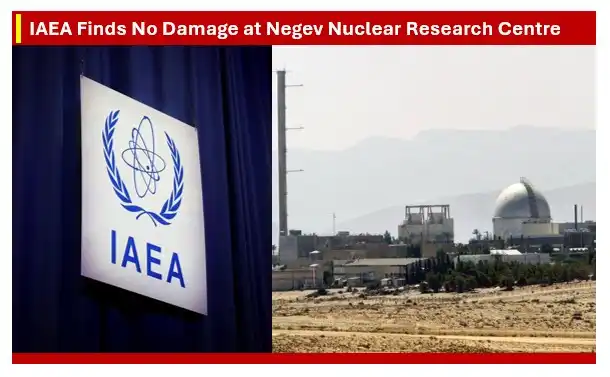
The international community is breathing the collective breath in silent alarm in certain moments when the frightening pace of the modern warfare defines the world more and more. That pause was succeeded on March 22, 2026, by a glimmer of relief. No destruction of the Shimon Peres Negev Nuclear Research Center situated in the desert near the city of Dimona was reported by the International Atomic Energy Agency (IAEA) after a night of high-level regional tension.
This is not only a statement spoken with the usual clinical impartiality of IAEA Director General Rafael Grossi, but whose weight is much greater than its limited wording. Dimona is not merely a facility in high stake theater of West Asian geopolitics; but a symbol, red line and the possible epicentre of a disaster that would not be respectful of any borders.
The Desert Watch: Night of Uncertainty
Negev Desert is a stark silent beauty, which is virtually endless as the horizon expands to infinity. But to the inhabitants of the neighbouring village of Dimona the silence was disturbed late on Saturday night by the regular throb of interceptors, and the far-off, rumbling thunder of explosions. With the screams of sirens echoing all through the southern district, the silver dome of the nuclear research center made the eyes of the world open.
Hours were filled with havoc in social media with untested grainy footage and panicked speculation. When there is a great depth of fake news and information warfare, fear speaks a lot where there is no official word. The IAEA verification, however, which is founded on satellite intelligence and direct communication with the Israelian nuclear authorities has offered a needed point of contact with reality.
read more:
- PM Modi greets people on Parsi New Year Navroz
- Govt amends National Highways Fee Rules, 2026
- Parliament to Discuss Railway Grants, Budget Expansion
The Human Element: living in the shadow of the Atom
The technical protection and structural health of the IAEA, but the human narrative of Dimona is that of silent stammering. The report of no damage is not a diplomatic triumph to the scientists, engineers and support staff who report to the facility on a daily basis; it is a personal triumph.
A Fragile Nuclear Diplomacy
The IAEA as the nuclear watchdog of the world has never been as vulnerable as it is becoming. The immediate update of the Director General Grossi is another important de-escalation tool. The IAEA is effective in soothing the fog of war that state actors like to use to justify retaliatory strikes because it gives an impartial, verified description of the circumstances.
Nonetheless, the accident has rekindled a hot debate among the world on the susceptibility of nuclear facilities in the active war zones. The no damage report is a fortunate get-out, but analysts believe that it should have been a wake-up call.
- The “Zaporizhzhia Precedent”: Since 2022 the world has been observing the dangers of militarized nuclear installations in Ukraine. The near miss at the Negev site makes the case that a specific no-strike international convention in the nuclear infrastructure.
- Reinventing Deterrence: The Negev facility has been shrouded in secrecy over the decades. High-precision drones and hypersonic technology are testing that protection in 2026, compelling a fundamentally different re-evaluation of physical and cyber protection.
