


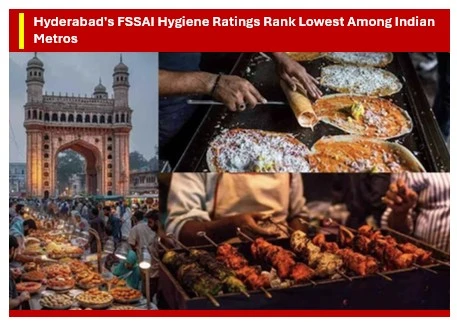
Hyderabad is widely regarded as one of India’s leading food destinations, celebrated for its iconic dishes and thriving restaurant culture. However, recent data reveals a sharp contrast between its culinary reputation and verified food hygiene standards, with only a small fraction of establishments participating in the Food Safety and Standards Authority of India (FSSAI) Hygiene Rating Scheme.
Hyderabad’s Food Industry Faces a Hygiene Rating Gap
Known for specialties such as biryani and haleem, Hyderabad has established itself as a prominent culinary hub that attracts visitors from across the country.
Despite this reputation, the city’s participation in the FSSAI Hygiene Rating Scheme remains limited. Of an estimated 75,000 food establishments operating in Hyderabad, only around 25,000 currently possess an FSSAI licence, while just 361 businesses have secured an FSSAI Hygiene Rating.
The figures place Hyderabad at the bottom among India’s major metropolitan cities in a programme designed to help consumers identify restaurants that have undergone an independent evaluation of their hygiene practices.
Read more: Aarya Sharma Set to Become Youngest Person to Visit All 63 US National Parks
What the FSSAI Hygiene Rating Measures
The FSSAI Hygiene Rating Scheme assesses restaurants using a one-to-five-star system based on several food safety parameters, including:
- Food handling practices
- Sanitation
- Employee hygiene
- Pest management
- Storage conditions
- Overall compliance with food safety standards
However, with only 361 certified establishments, less than two percent of licensed restaurants—and an even smaller share of the city’s total food businesses—have received the rating.
As a result, most customers have no official way to determine whether a restaurant’s hygiene standards have been independently assessed before choosing where to eat.
Read more: Why mosquitoes bite some people more than others?
Voluntary Nature of the Scheme Limits Participation
According to the report, the low participation rate is not necessarily an indication that restaurants disregard food safety.
Instead, the primary reason is that the FSSAI Hygiene Rating Scheme is voluntary. Restaurants are free to continue operating without applying for certification. Although food safety officials encourage businesses to seek ratings during inspections, there is no legal requirement to undergo the evaluation.
Consequently, adoption depends largely on the priorities of individual restaurant owners rather than an industry-wide expectation.
Why Low Participation Reduces Consumer Awareness
Voluntary transparency programmes often produce uneven participation.
Restaurants with well-established food safety systems are generally more willing to undergo independent assessments because positive ratings can strengthen customer confidence. Meanwhile, businesses that view certification as an additional operational burden or see limited commercial benefit may choose not to participate.
When only a small percentage of restaurants display hygiene ratings, the absence of a rating becomes common rather than informative. This leaves consumers with little objective information to compare hygiene standards across dining establishments.
Food Safety Expectations Continue to Grow Across India
The challenge is not limited to Hyderabad.
India’s food service industry has expanded rapidly over the past decade, supported by organised restaurant chains, cloud kitchens, food delivery platforms and rising consumer demand.
Alongside this growth, regulators, institutional buyers and increasingly informed consumers have placed greater emphasis on documented hygiene practices, operational consistency and independently verified compliance instead of relying solely on brand reputation or customer reviews.
Expert Highlights the Challenge of Voluntary Transparency
Commenting on Hyderabad’s low participation, Ashwin Bhadri, Founder and CEO of Equinox Labs, said the numbers demonstrate the limitations of voluntary transparency systems.
He stated:
“A hygiene rating becomes valuable only when consumers can meaningfully compare establishments across the market. If only a very small proportion of businesses participate, the absence of a rating no longer tells consumers anything useful because it describes most restaurants rather than a small minority. The objective should not simply be to increase the number of certificates issued but to encourage consistent food safety practices that businesses are confident enough to have independently evaluated.”
Hygiene Standards Are Becoming a Business Advantage
The report notes that food safety documentation is becoming increasingly important as businesses compete not only for individual customers but also for institutional contracts, corporate cafeterias and partnerships with organised food service platforms.
In many cases, independently verified hygiene standards are evolving beyond regulatory compliance and are becoming an indicator of operational credibility and long-term reliability.
Conclusion
Hyderabad’s standing as India’s lowest-ranked major metro in the FSSAI Hygiene Rating Scheme highlights the broader challenge of encouraging voluntary participation in food safety transparency programmes.
While the city continues to enjoy a strong culinary reputation, its verified hygiene infrastructure has not expanded at the same pace. Until participation in the hygiene rating programme becomes more widespread, consumers will continue to rely largely on restaurant reputation rather than independently verified assessments of kitchen hygiene.
