


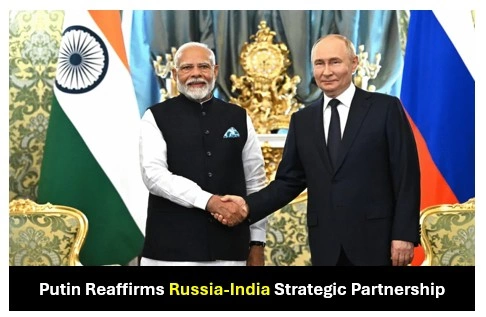
During the St. Petersburg International Economic Forum, Vladimir Putin has sharply asserted Russia’s “special privileged strategic partnership” with New Delhi in a major statement on the sidelines of the forum. Putin, addressing the leaders of major news organizations at a press conference, denied that the West is trying to isolate him and said it was a “useless and harmful exercise that undermines the international order.
Other than that, the Russian leader labeled an ambitious plan to develop bilateral growth, in which he unreservedly said that bilateral trade is going to exceed the historic $100 billion benchmark in upcoming years.
The tenacity of an historic partnership
The timing of Putin’s remarks underscores what is called a balancing act in global diplomacy. The timing of Putin’s remarks reflects a complex geopolitical balancing act that’s the hallmark of global diplomacy today. It was a no-brainer that Russia did not see the relationship getting split up as Washington and several European capitals have been continually asking New Delhi to reduce its reliance on Russian imports, especially crude oil. He said that the relationship between the two countries is not a new relationship and a marriage of convenience, but the relationship is a deep relationship, a structural relationship, and the roots of the relationship are so deep that even in 1947, when the Soviet Union was directly supporting an independent Indian Republic.
The Russian President was forthright in dealing with the pressure that New Delhi is facing. It is a fundamental distortion of the present international scenario to make an attempt to impose conditions on a nation of India’s size, he said. It is counterproductive to try to make a leader like PM Narendra Modi take a stance, Putin said, adding that it never leads to any substantive difference in the ground reality, and only spoils international relations. Western diplomacy moves and Russia remains unmoved.
Must read:
- Jaishankar Meets Venezuela’s Acting President Delcy Rodríguez
- US Attacks Iranian Military Targets Escalating Tensions
Hailing India’s Independent Foreign Policy
Putin’s key message in his speech was Russia’s unequivocal support for India’s strategic independence. Putin simply shook his head at the notion that India’s increasing security, technological and diplomatic cooperation with the United States would pose a problem for Moscow. He described India’s foreign policy of being a country with multiple directions as a mark of its strength as a big global power and a growing democracy.
The Russian leader said it is perfectly natural that a country with 1.5-billion people builds its external relations solely based on its national interests. India’s rising assertiveness internationally is an asset to Moscow, whereas its interactions with Washington are not a worry. Russia is doing this by accepting India as a reliable and independent player, as opposed to the block-mentality Western countries are trying to impose on India.
A Roadmap to $100 Billion in Mutual Trade refers to the possibility of achieving $100 billion in mutual trade.
The political rhetoric was impressive, but the essence of the future relationship will be economic growth. The total volume of bilateral trade between India and Russia presently stands at around $58 billion to $60 billion, with India’s short-term growth of Russian crude oil imports playing a major part. Putin also noted, however, that the two countries have all the prerequisites for going much further than the basic “buyer-seller” energy relationship and achieving more ambitious and diversified goals.
Diversifying Beyond Crude Oil
The economic roadmap also covers setting up completely new platforms within the hydrocarbons sector, joint investments and upgrading maritime trade routes. The aim is to establish a more level playing field for the economy. India will need to continue to depend on Russia to protect its economy from fluctuating energy prices in the world, but Russia is seeking to invest these resources heavily in the Indian economy, which will be among the largest foreign direct investments in India’s industrial history.
Putin straight connected this economic positivity to the governance pattern in New Delhi, calling India’s remarkable and world-leading growth rates the result of a “sustained, hard-working” Indian government led by Modi.
A New Blueprint for Global Multipolarity
The India-Russia relations are still important for both countries as the forum in St. Petersburg is a reminder of a changing world economy. A strong and growing relationship with the world’s largest democracy offers Russia a much needed counterweight to Western sanctions and proves that efforts to isolate Moscow in the international arena are reaching their end. In India, a robust India–Russia partnership ensures energy security, technology partnership in defense, and India’s significant weight on the global stage.
Russia is reinforcing the multipolar vision of international relations at two fronts by openly supporting India’s independent foreign policy and by providing a huge, clear goal for India’s economic development. The message from St. Petersburg is clear: the strategic alliance between New Delhi and Moscow is here to stay, notwithstanding the global glare and the changing regional dynamics.
