


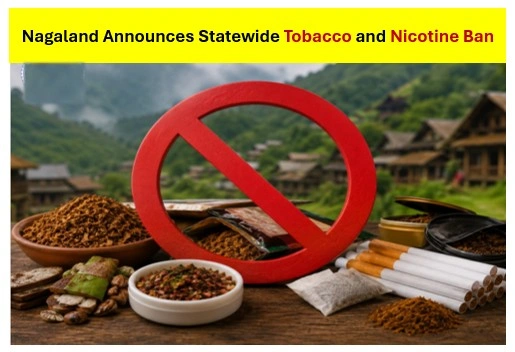
Public health governance doesn’t normally go to the extreme of shutting down a market, but when the core health of a people is at stake, then administrative half measures must be eliminated. The Government of Nagaland has approved the introduction of a blanket ban on manufacturing, processing, storage, transportation and sale of any food products containing tobacco or nicotine throughout the state for a period of one year in a highly decisive and sweeping order.
The detailed, straight-to-the-point order is handed down by the Commissioner of Food Safety himself. The move removes the legal hurdle from individual decisions about tobacco usage and subjects the state to a new and powerful administrative tool that will be effective in systematically reducing the availability of smokeless tobacco.
The Legal & Regulatory Basis of the Ban
To appreciate the importance of this policy change, it is important to understand the peculiarities of the legal framework under which tobacco has been regulated in India over the years. Commercial manufacturers have been happy with the murky waters that existed between agricultural products and luxury items for decades.
But, on the legal side, the existing intervention in Nagaland is based on Section 30 of the Food Safety and Standards Act of 2006, in conjunction with the country’s legislative framework from 2011 which clearly states that tobacco and nicotine cannot legally be used as ingredients in any product that falls under the food category. The state has essentially removed a key legal defense from manufacturers when it classifies any substance that can be chewed and eaten as a food product.
read more: Massive fire breakout in Delhi hotel PM announces aid
Closing the Loophole, Cracking Down on Twin-Pack Tactics
The ban is direct out of years of corporate evasiveness. The Indian government introduced the first wave of state-level gutkha bans over 10 years ago and the industry responded quickly. They were pioneers in conjoint or “twin pack” marketing. They started selling pre-mixed tobacco in the betel nut mixture and pure pan masala in a separate packet, which is attached to the pan masala. Retailers sold these twin packs together with identical counters – the consumer’s job is to mix the two dangerous ingredients at the last minute before eating. This little loophole had a big impact on the original purpose of state public health laws.
This has been banned altogether by the new directive issued by Kohima.
The prohibition is in clear language, addressing the food products whether packaged as a single item or sold as the individual, separate and companion parts of a food product that are intended by the end-user to come together. If a product contains tobacco or nicotine as a last ingredient, it is contraband upon crossing the state border, regardless of what the product is called and how it is packaged. Tobacco or nicotine is a final ingredient, so a product becomes contraband the moment it enters the state border, regardless of how it is called or packaged.
read more: Government takes action against CBSE Chairman and secretary transferred
The Direct Lifeline for Children and Young Adults
For medical practitioners in the area, the human toll of this incendiary change in policy is a reality. Historically, Nagaland has been one of the states with the highest tobacco consumption rates in the country, hitting almost forty-three per cent of its adult population with active tobacco consumption. Even more alarming to local health officials is the fast and silent introduction of smokeless tobacco to teenagers and school aged children. These brightly-colored, intensely flavored, and cheap nicotine pouches are very easy to hide in classrooms and public areas in today’s market.
This silent epidemic is manifesting itself in appalling numbers in regional clinics. Oral Surgeons and dental doctors in urban centres such as Dimapur and Kohima have repeatedly cautioned of an unprecedented rise in the early stage of Oral Submucous Fibrosis in youths. It is a chronic, painful, pre-cancerous condition that greatly limits the movement of the jaw and often develops into life-threatening oral cancers later in life.
read more: Gunshots Fired Outside Khan Sir’s Coaching Centre in Patna
Moving Beyond Awareness: Comprehensive Enforcement
Strictly enforcing such a blanket ban is a huge task logistically and the state is stepping away from merely passive border checks. The implementation comes after months of more grievance letters sent to administrative officials, and a recent effort by the Department of Health and Family Welfare to establish very strict vendor licensing procedures via local municipal corporations.
Enforcement squads issued hundreds of penalties for infractions of the tobacco-free zones around schools during the past year, showing that so far warning signs have little effect on curbing the profits of profit-driven street vendors.
A stepped-up enforcement system is in place to put this one-year ban into practice. The State Empowered Committee is conducting intensive retail sweeps, simultaneously working in close coordination with the district administration teams and local police departments, and setting up permanent checkpoints on inter-state highways to stop trucks that are coming in with supplies.
