


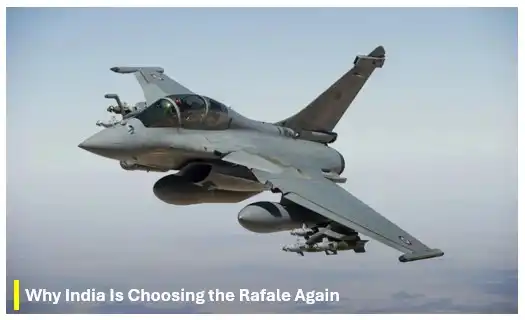
India is getting ready to depend even more on the Dassault Rafale as it tries to quickly improve its fighting power in a dangerous region. The new push isn’t just about getting more jets; it’s also about being quick, ready, and using a tool that pilots and ground staff already know how to use.
The plane has shown that it can handle a variety of tasks, from air control to deep strike, since it was first put into service with the Indian Air Force. Now, people in charge think that adding more ships to the same group might be the fastest way to fill in important holes.
The Problem of Not Enough Squadrons
Planners have been saying for years that the number of active fighter groups is not as high as it should be. Older planes are being retired, but substitutes have not come in large enough numbers. Because of this, there is pressure to act quickly.
By getting more Rafales, we can skip the long wait that comes with reviewing brand-new candidates. There are already training methods, upkeep sets, ways to use guns, and strategies in place. Adding more of the same type of jet makes the force bigger without having to start from scratch.
The reasoning is easy to understand: when time is short, experience can help with strategy.
Ready for battle and able to play more than one role
People like the Rafale because it can do many things in one flight. It has modern sensors and electronic warfare systems that help it switch between air battle, ground attack, and observation.
Military leaders think this is very important, especially since there are threats from both the western and northern borders. It’s not necessary to send out as many specialized planes when you have a jet that can change quickly in the air.
It’s also appealing that it can carry a lot of different current guns. Instead of trying out a system that hasn’t been tried before, planners are moving toward something that has worked well in real operations and foreign drills.
Giving Strength to the Seas
The air force isn’t the only one interested in Rafale planes again. India has also taken steps to improve military flying through the Indian Navy. India will be able to reach more places across the Indian Ocean with the marine form of the fighter, which will be able to operate from ships like INS Vikrant.
Fighters that are based on carriers are very important for keeping sea lanes safe and displaying power far from the coast. It might be easier to handle operations and long-term support if the Navy and Air Force bought the same things.
Industry Growth and a Focus on the Local
The push for more local participation is another important issue. India’s government wants more work to be done in production, service, and sales. Adding more planes to the Rafale program could help local companies learn how to make high-end aircraft products.
If talks go in that way, the project could create jobs, improve technical know how, and, over time, make it less necessary to get repairs done in other countries.
Why not try something new?
Next-generation stealth weapons get a lot of attention around the world. But these kinds of projects can come with more risk, longer completion times, and tougher talks.
India’s present thinking seems to be based on speed. We need to make things stronger right now, not ten years from now. By picking a platform that already flies its flag, the country can increase its capabilities while lowering the risk of failure.
India’s increased faith in the Rafale sends a strong message. In a time of fast change and competition in different areas, it may be more important to show that you are ready than to get the newest name. In the years to come, we’ll see how this new way of doing things changes the balance in the sky.
