


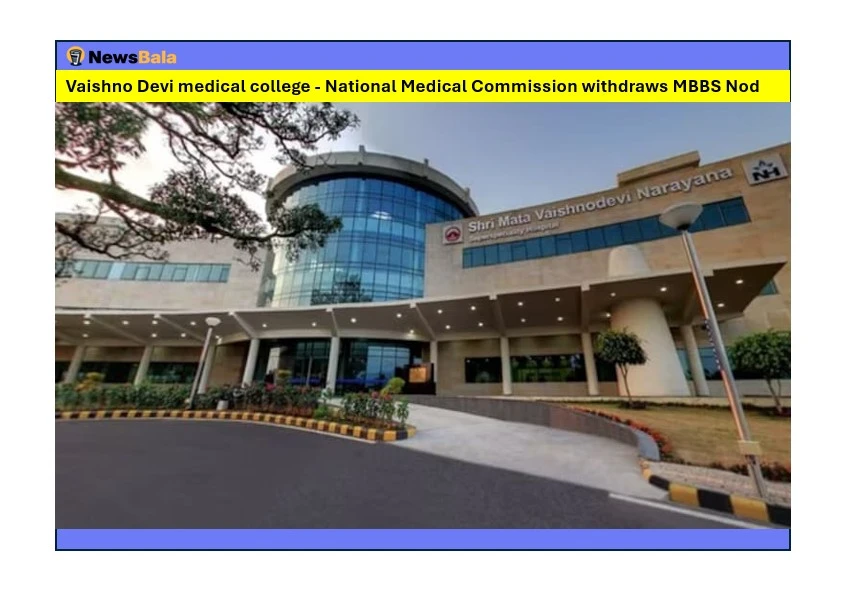
The National Medical Commission, which is an apex body for medical education in India, withdrew the Letter of Permission given to The Shri Mata Vaishno Devi Institute of Medical Excellence. It is supposed to open an MBBS course with an intake capacity of 50 seats for the 2025-26 session. This withdrawal became effective immediately.
Why Was the Nod Was Withdrawn?
The revocation of the college’s approval by the Medical Assessment and Rating Board (MARB) of the NMC is mainly attributed to severe non-compliance with the minimal regulatory standards necessary to operate an undergraduate medical course. This happened after the commission received complaints of possible infrastructural, materials, as well as faculty inadequacy among other requisite essentials.
As per the inspection findings:
- The number of teaching faculty members was found to be significantly below the required standard.
- The lack of tutors, demonstrators, and senior residents made it hard for effective teaching.
- Clinical infrastructure, number of patients, and bed occupancy ratios were below the required standards.
- Certain laboratory and academic facilities like practical laboratories, research facilities, and a library were inadequate.
Under the Establishment of Medical Institutions, Assessment and Rating Regulations, 2023, such non-compliance is treated as a violation that can attract penalties including cancellation of permission to offer medical education. MARB invoked these provisions and with the approval of the chairman, the NMC revoked the institute permission.
What Happens to the Ones who get Admitted?
While passing its order, the NMC made it clear that no student would be deprived of a seat in the MBBS course due to withdrawal. The commission ordered that the students who were already admitted during NEET-UG counselling for the 2025-26 session-on the basis of merit-will be accommodated as supernumerary seats in multiple recognized medical colleges within the Union Territory of J&K. This shifting process has formally been ordered to the concerned health and counselling authorities of the Union Territory. The step will serve the purpose of saving the academic interests of the students while maintaining regulatory requirements.
Context: Admission Controversy and Protests
It has come as the backdrop to the controversy surrounding the list of students included in the inaugural batch of admissions at SMVDIME. Out of the 50 MBBS seats the college possesses, the majority of the 50 MBBS seats were filled by Muslim students, 42 to be exact, including one Sikh student. This led to widespread protests involving local and hindutvad groups such as the Shri Mata Vaishno Devi Sangarsh Samiti (SMVDSS) and other groups protesting the list of students and the need for the admission list to be altered in favor of Hindus, as the college was established through contributions of Hindus who frequent the pilgrim site every year.
The protests gained momentum over the past few weeks, with protesters demanding that the medical college be closed down due to its failure to fit the community profile or ethos.
Political Reactions and Legal Debate
The Bhillawan controversy brought the matter under the limelight. Merely on the basis of NEET-UG, students were allotted admission on the basis of merit, and the other groups should take steps to get the status of a minority institution if any changes were to be implemented.
Legal scholars have also raised concern that if the merit-based admissions system is canceled based on grounds other than regulatory requirements, the constitutional system and the fair process of competitive exams might be affected as the admissions, following set rules, cannot be annulled for the lack of legal reason.
Wider Implications
The NMC decision has wide-ranging implications for enforcement in ensuring regulatory standards in medical education, indicating a tough stand taken by them on regulatory requirements, even in institutions that are relatively new. At the same time, it also brings out how educational administration sometimes intersects with socio-politics, especially in areas that are sensitive around concerns for identity and representation, particularly in certain geographies that are marked by complex dynamics around these imperatives. The future course for medical education policies, as well as rights to admission for minorities, could become a subject for judicial review cases in the next few months.
