


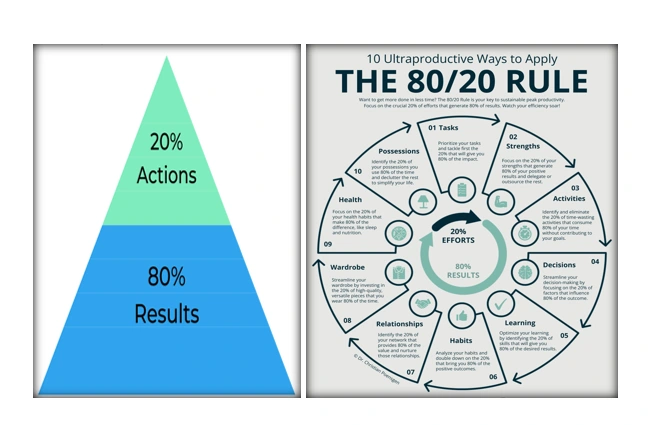
According to the Pareto Principle—the 80/20 Rule—most outcomes (approx. 80%) derived from judging by a programmed total of 20% of habits, triggers or relationships will result in approximately 80% gain across the following:
- Recognizing and taking action on the 20% of positive habits that improve your moods.
- Recognizing and taking action on the 20% of triggers causing your most negative experiences (stress/anxiety).
The results generated by applying these 80/20 principles will lead to a more simplistic pathway to improvements to your overall emotional well-being.
Impactful Work-Related Habits
Many of the high-impact work-related habits drive improvement in emotional and relationship stability and resilience:
- Sleeping enough well
- Regular physical exercise
- Connecting meaningfully with other people
- Mindfulness/Quiet time
- Impacted Relationships
Of all of the people you are currently connected with, there are likely many individuals who affect you positively and negatively.
While very few of the people in your life have the ability to provide you with the level of support you desire; there will be many that drain your time and energy.
The “20% That Hurts the Most”
1. Major Stress Triggers
Some of the most significant sources of stress are having a toxic work environment, a lot of financial stress, unresolved issues and conflicts, and digital overload (e.g. too many notifications and social comparison from social media.
Identifying a few of these stressors and working to reduce exposure has shown to lower one’s anxiety levels.
2. Thought Patterns
There are many negative ways of thinking that can motivate much of a person’s distress; however, some of the most common are:
- Catastrophizing
- Overgeneralizing
- Being rough on oneself
Challenging these patterns has more potential to improve overall mental health than trying to regulate every thought.
Read also: 2026 Mental Reset Guide
How to Practically Use This Rule?
1. Audit Your Mental Energy
To do this ask yourself:
How do I feel after doing different activities? Which activities do I consistently find leave me feeling more drained than before I did them?
Do more of what makes you feel good; less of what makes you feel negative.
2. Simplify Self-Care
Select 2-3 self-care behaviours that are easy to continue doing, and have had a noticeable positive effect. Be consistent with your self-care behaviours, rather than trying a variety of behaviours.
3. Set Boundaries
Be strategic about where you say “no”, in order to:
- Prevent ongoing sources of stress
- Protect your time and mental energy
Read also: How One Influencer Is Redefining Parental Support in Mental Health ?
Advantages of the 80 / 20 Rule
- Reduces feelings of overwhelm through focus
- Increases effectiveness of self-care activity
- Increases clarity around what truly matters
- Supports long-term behaviour change as opposed to burn-out.
Limitations to Keep in Mind
The 80/20 rule serves as a general guideline for evaluating mental health, but should not be seen as an exact science. Mental health can be extremely complicated, and some issues will require intervention from a professional, while others cannot be oversimplified.
This rule should be used as one strategy among many to help with prioritizing issues, rather than as a substitute for obtaining more complete treatment when necessary.
Read also: Impact of social media on mental health
Conclusion
The 80/20 rule for enhancing your mental wellness means working smarter, not harder. By determining and concentrating only on the few (but important) things that will make the largest difference in how good you feel and how you feel about yourself, you will be able to improve without feeling overwhelmed with too many things impacting your mental wellness.
