


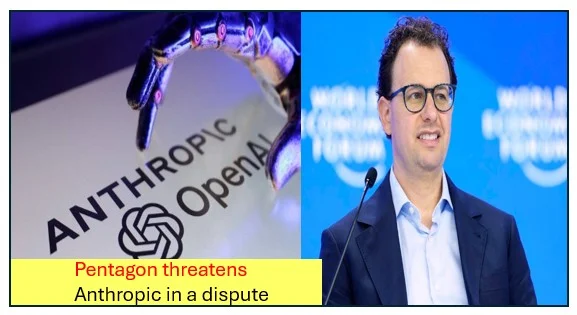
According to a report by the Defense Department, it is searching for a way to end its relationship with AI company Anthropic because of ongoing differences over how Anthropic can provide the military with AI solutions for various military applications. The military believes that Anthropic has placed unreasonable restrictions on its use of AI solutions for intelligence collection, as well as command and control functions and conducting military strike operations with AI.
The key point of contention in the dispute centers on what “all lawful purposes” means to Anthropic as far as allowing military usage of AI for intelligence collection, command and control functions and conducting military strikes using AI (assuming that those usages are then deemed “lawful” under the Department of Defense’s definition).
It has been reported that U.S. government officials are weighing the option of terminating their partnership with Anthropic in an attempt to force Anthropic to change its position on this matter.
Why this dispute is important: To find a resolution that protects safety while providing the military with the methods to utilize these systems in a manner that meets the military’s requirement for using these systems.
Anthropic, which is the company responsible for the creation of Claude, has positioned itself as an ethical leader in the AI field by adhering to a strict code of ethics regarding the use of its products. As such, the company has set strict guidelines regarding the use of its products, such as prohibiting the use of AI to autonomously identify and target possible targets; conducting mass surveillance of the general population; or any other method deemed to carry a high degree of liability.
While there are several examples of AI technologies meeting federal standards for military applications, the Pentagon has found several scenarios in which these technologies could not be deployed due to the Pentagon’s requirement that they be used in a manner that is consistent with ethical standards. The conflicting views of these two parties have led to significant concerns from the Pentagon regarding the ability of the two parties to negotiate a contract that would guarantee the Pentagon approximately $200 million worth of annual procurement of AI products.
The Pentagon has also cited a dispute regarding the involvement of Anthropic’s AI model, Claude, in the U.S. military’s covert operation against Nicolás Maduro’s regime in Venezuela as another reason to sever their agreement. Anthropic has denied any involvement, claiming that it has not had discussions with the Pentagon regarding the use of Claude in any operational contexts and has not authorized the military to use Claude other than as permitted under internal policy.
Even though the Pentagon nor coal has reported any military involvement in the use of Claude for this use so far, the incident has raised concerns; both in terms of whether the company followed it’s guidelines and how AI is considered to be a participant in military actions.
Economic Context: AI in Defense & Access to Classified Networks
The disagreement between the two organizations is taking place at the same time as the Pentagon tries to implement cutting-edge artificial intelligence systems onto both classified and unclassified platforms. The Pentagon has requested Anthropic, OpenAI, Google, and Elon Musk’s xAI to allow their systems to be utilized for classified military purposes without some of the limitations that normally restrict civilian use.
Certain companies such as OpenAI have agreed to use “scaled back guards” on unbiassed Peninsula systems, however the process of expanding that access to classified systems currently continues to create animosity between the various companies. As such, to this date only Anthropic has granted the use of their model on a classified basis based on strict and safe guidelines set by other parties; hence the continual friction.
With the increase in the importance of artificial intelligence technology to the defense sector, the Pentagon is looking to deploy these technologies as quickly as possible in order to analyze large amounts of data, assist in making battlefield decisions, and improve operational plans. While many defense officials and experts agree that lifting restrictions on the keys for AI technologies running on military systems will create additional risk (including inaccuracies) with respect to high value items being used in a combat situation, many users of the technology do not view those risks as sufficient enough to warrant following current regulations.
Stakeholder Statements and Next Steps
Anthropic continues to maintain that its discussions with the government have focused on usage policies (not working on areas of deployment). In addition, Anthropic believes that safety boundaries need to exist even within the context of defense.
The company has repeatedly pointed out through public channels that AI supports national security, but we need to avoid applying it in a way that would make us similar to our authoritarian adversaries.
The Pentagon has not publicly responded to the reported intent of the Pentagon to terminate its relationship, although in defense-based meetings, defense officials have alluded to increased demand for broadly deployable AI tools.
Ultimately, how the situation between the Department of Defense and Anthropic develops may impact how commercial Ai companies partner with DOD and other national security organizations and how ethical protections connected with commercial AI interact with government desires to have access to high-performance and flexible technologies.
