


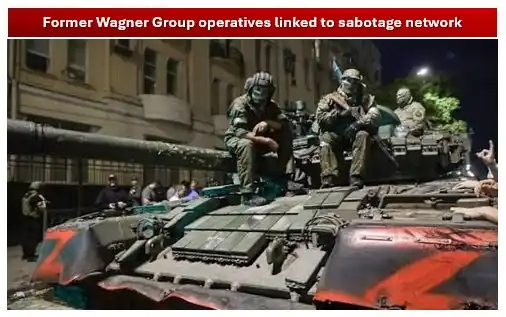
According to Western intelligence officers, there are still parts of the former despicable Russian private military company known as Wagner Group that play a significant part in pursuing a Kremlin-directed sabotage and reconnaissance network throughout Europe (the European Union). This network is being carried out with the cooperation of ex-Wagner recruiters and propagandists who now work with Russian intelligence services to create “disposable” agents to carry out covertly with missions in NATO countries.
Wagner Operatives at Heart of New Sabotage Network, Western Intel Says
Since Yevgeny Prigozhin, the founder of Wagner, died and the group was disbanded following their short-lived mutiny in 2023, Moscow has been utilizing Wagner’s existing social media channels as well as the expertise of the organization to carry out operations that are outside of the normal conflict parameters. These actors are targeting civilians as well as people in vulnerable positions by taking advantage of elements of social and economic vulnerability to create opportunities for these individuals to carry out acts of sabotage against various European nations.
Shift from battlefield to hybrid warfare
With the diminished ability of the Russian government to conduct diplomacy or intelligence in traditional ways due to the expulsion of Russian officials from Europe and increased counter-intelligence activities of EU nations, the FSB (Federal Security Service) and GRU (Military Intelligence) are utilizing Wagner-funded individuals as a less-expensive solution for training, recruiting and deploying covert agents to carry out sabotage, reconnaissance and influence operations.
These “disposable agents” or “one-time-use agents” have been involved in a variety of activities, including committing small acts of vandalism against infrastructure and humanitarian aid depots, arson against infrastructure, collecting information on NATO installations, by using “shadow fleet” vessels to facilitate this task located in both the Mediterranean Sea and the Baltic Sea.
Case Studies: Real World Attacks Associated with Wagner Networks
One high-profile example that highlights the concerns regarding these networks occurred in the United Kingdom in which British courts have charged and found guilty of committing arson attacks against people connected to Wagner’s channels. Specifically, in one incident, a 21-year-old man who was recruited via social media conducted an arson attack on a container facility that contained equipment bound for Ukraine; this individual was sentenced to an extended period of imprisonment for his actions.
Earlier actions by law enforcement in Poland have resulted in the convictions of two men who were convicted of espionage and terrorism-related offenses for their involvement in Wagner recruitment activities throughout European cities; these individuals were determined to have been distributing coded materials and propaganda used in recruiting activities throughout various capitals in Europe, demonstrating how hybrid warfare and recruitment have permeated European soil.
According to security experts, these prosecutions represent important developments in fighting against hybrid warfare tactics; therefore, an incrementally increasing capacity within EU law enforcement agencies exists to detect and dismantle concealed networks prior to their causing any significant level of disruption across Europe.
European Security Agencies Are Working Hard to Combat the Threat
European Security and Intelligence Agencies are currently attempting to develop a complete understanding of the extent of Wagner sponsored/supported sabotage cells and how to stop the recruitment flow into Wagner and to dismantle the operational structure used to support these operatives. The magnitude of this task is considerable; many of these operatives communicate using encrypted messaging systems, work through informal networks, and utilize third party entities to disguise any direct connection to Moscow.
These officials have stated that this network is not a group of marginal individuals, but is part of a larger Russian hybrid warfare strategy aimed at injuring Western unity and diminishing Western support for Ukraine; this approach is done without triggering a large scale military conflict. This hybrid warfare strategy includes techniques such as covert sabotage, disinformation, economic coercion, and political manipulation.
Implications for NATO and EU Security Posture
The increased use of ex-Wagner personnel for sabotage and intelligence-gathering operations highlights an evolving Russian approach to warfare, moving away from conventional methods of establishing dominance on the battlefield and towards hybrid campaigns aimed at undermining civil society, disrupting critical national infrastructure and sowing discord among allied countries. To counteract these new forms of attack, analysts believe that it will take a combination of improved intelligence sharing, legal remedies and coordinated deterrence strategies that will ensure that both state and non-state actors are held accountable for their hybrid activities.
For European capitals, addressing the current and future hybrid policies employed by Moscow is not only about balancing civil liberties or addressing domestic intelligence capabilities, but rather how to anticipate if and how the Russian government continues its adaptive used tactics in light of ongoing geopolitical tensions.
