


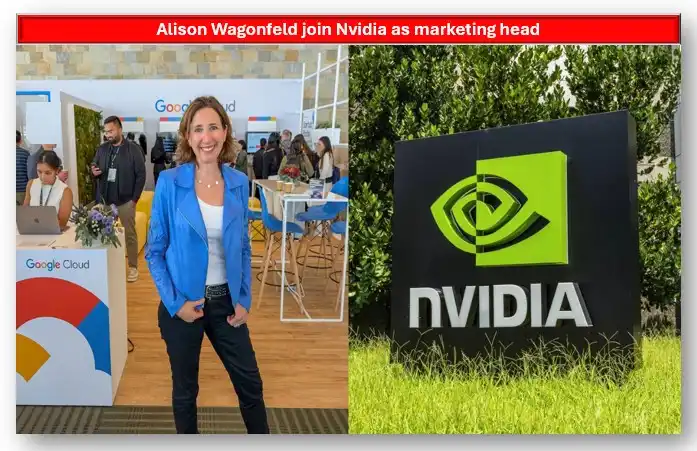
Nvidia’s has hired its first Chief Marketing Officer (CMO) in a major ramp up of the company’s marketing efforts. Wagonfeld, who spent a decade at Google Cloud, joins Nvidia in this newly created position at a time when the company is transforming from giant in the hardware business to become the chief architect of the world’s AI economy.
The announcement, made on Jan. 9, 2026, is the end of an era at Google Cloud and the start of a more “intentional” storyline for the world’s most valuable chipmaker.
The Architect of the $60 Billion Run-Rate
Wagonfeld’s exit is a big loss for Google. She helped lead Google Cloud from a scrappy challenger into a $60 billion-a-year revenue machine after joining in 2016.
She referred in her farewell post on LinkedIn to “multi phases of scale and transformation” over a decade at Google. During her time there, Google Cloud grew beyond its search-and-ads origins to become a titan in cloud infrastructure, Workspace productivity and enterprise AI. Now, she is bringing those “scale-up” skills to a company that is currently tacking on trillions in market cap at a dizzying rate.
Why Nvidia Needs a CMO Now?
For years, Nvidia CEO Jensen Huang was notorious for letting the company’s technological prowess do all of the talking. It worked: Nvidia’s GPUs emerged as the “gold” in the AI gold rush. Yet as the company heads into 2026, the picture has shifted.
Nvidia is no longer peddling chips alone; it’s selling a whole environment — ranging from Blackwell and Rubin architectures to the CUDA software platform and self-driving car models like Alpamayo.
The decision to establish the CMO position reflects that Nvidia is working to centralize its marketing and communication efforts, which had previously been somewhat decentralized, managed by multiple divisions. Wagonfeld – who will report directly to Jensen Huang, Nvidia chief executive officer – will oversee the following:
- Bridging the gap: Bringing Nvidia’s story together with its data center, gaming and robotics viewpoints.
- Putting the Sheen on the Brand: Elevating Nvidia from “component company” to a “platform leader,” in its public standing.
- Managing Growth Pains: How the company is dealing with scrutiny as a $5 trillion company, and trying to keep its “rockstar” C.E.O. can-do attitude.
“One AI Leader to Another”
Wagonfeld’s exit is unusual because it isn’t the kind of “defection” we would normally think about. Google and Nvidia are close partners; Google Cloud is one of the biggest purchasers of Nvidia’s high-end H100 and H200 chips.
Wagonfeld was careful to make note of this in her announcement, saying she was “excited to be moving from one AI leader to another” and that the two leaders would certainly continue to work together. For Nvidia, which sells the AI chips that power its supercomputers, scooping up a top executive from one of its largest customers should provide crucial “buyer-side” perspective as it designs future AI supercomputers.
A New Era of Competition
Wagonfeld officially takes over in February 2026. She arrives as the competition heats up in computing, with rivals like AMD and custom silicon efforts from Amazon and Microsoft gaining momentum.
Her first big challenge? Translating Nvidia’s arcane technological feats — such as the 90% token generation cost savings promised by the new Rubin platform — into a story that can resonate with investors and enterprise leaders now deeply preoccupied with just how “sustainable” this AI boom is going to be.
As she enters Nvidia’s Santa Clara headquarters, the tech world will be waiting to see if she can do for the “AI Hardware King” what she did for Google Cloud: help shepherd a time of explosive, chaotic growth into a disciplined, multidecade legacy.
