


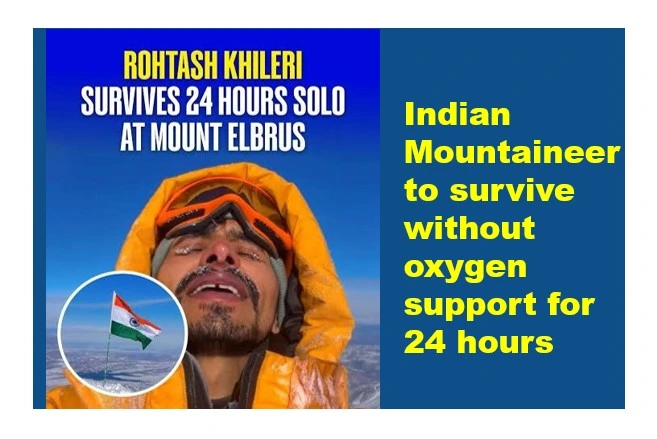
Indian mountaineer Rohtash Khileri has made a historical mark in mountain climbing by emerging as the first ever person to have stayed at the top of Mount Elbrus, which is Europe’s highest mountain and requires no oxygen to stay alive in a span of 24 hours. This act is an epitome of adventure and a challenging proof of endurance because climbing Mount Elbrus without supplemental oxygen is a challenging adventure in itself.
Mount Elbrus, a mountain in the Caucasus mountain range in Russia, stands at a staggering 18,510 feet (5,642 meters) above sea level. While not as tall as other mountains in the world, its extreme climatic conditions, biting winds, and low atmospheric oxygen concentrations make staying in its summit a highly daunting task, even for an adept climber. The extreme low temperatures in Mount Elbrus can easily go below -40°C, with wind chill having an effect that digs deeper into one’s skin than that in most other mountains in the world.
Being a native of the state of Haryana, Rohtash Khileri is already aware of the challenges associated with mountaineering at a high altitude. In the past ten years, he has ardently worked towards the achievement of his dream to challenge the limits of the human body in adverse climatic conditions. His success at Elbrus Mountain was the result of eight long years.
An Eight-Year Journey of Dreams and Perseverance
Khileri’s journey started as far back as 2018, and his very aim was not only to climb Mt Elbrus, but also to survive the entire day at the summit without the help of supplemental oxygen. This was his very first attempt at the feat and resulted in the success of the summit climb, although the 24-hour mission was not accomplished. Since then, he has made a number of attempts at the completion of his dream.
Khileri was confronted with a moral dilemma in the year 2020 when he decided to forego a record attempt in order to help a fellow mountaineer in distress. However, in the year 2023, he was compelled to climb down due to severe weather conditions after merely four hours of reaching the peak.
These setbacks might have defeated many, yet Khileri’s resolve only hardened. Following a gruelling preparation this time-including high-altitude acclimatization, intense physical conditioning, and meticulous planning-he returned to Mount Elbrus in early 2026 to make one final attempt at the world record.
Battling the Elements: 24 Hours at the Edge
On January 21, 2026, Khileri reached the top of Mount Elbrus and began what would become an excruciating 24-hour vigil. No bottled oxygen to see him through, no fixed tents to take refuge in, and no companions willing to brave the extreme conditions, he endured the pitiless cold, hurricane-force winds, and extreme oxygen deprivation alone. It was as unforgiving an environment as mountaineering gets: temperatures fell to as low as -50 °C, with wind gusts higher than 60 km/h, with the air at that altitude carrying little more than half the oxygen available at sea level.
The fact that Khileri was surviving without supplemental oxygen is a tremendous physiological feat. As Khileri climbed higher, it was as if the body was deprived of oxygen—it’s what mountain climbers term hypoxia. Going higher puts a climber at great risk from altitude sickness, swelling of the brain (HACE), or even death. Yet Khileri, thanks to extensive training from years of high-altitude climbing expeditions like Everest or Africa’s Kilimanjaro, carefully watched out for himself as he struggled with frostbite, numbed limbs, and hypothermia.
A Story of Sacrifice, Spirit, and National Pride
Khileri’s success did not come easily to him. Along the way in realizing his dreams, Khileri had to suffer from frostbite, which led to the amputations of two of his fingers. But despite this painful reality, Khileri did not let this setback dampen his spirits. After overcoming the 24-hour ordeal, Khileri dedicated his success to the Indian flag and to every individual who dreams big despite overwhelming odds.
It is more than a personal achievement; it also celebrates the strength of the human spirit. The success of Khileri serves not only as a motivation for mountain climbers. It provides a beacon of hope and motivation for all athletes and common citizens. It is also a lesson that, when the world places boundaries even before the dreams are born, success like that on the icy side of Mountain Elbrus defies the boundaries and the limits.
As the congratulatory messages pour in, Rohtash Khileri’s name is now up there with the likes of explorers who have not only stepped on the rooftops of continents but have lingered on them, living to tell the tale, all of that without oxygen.
