


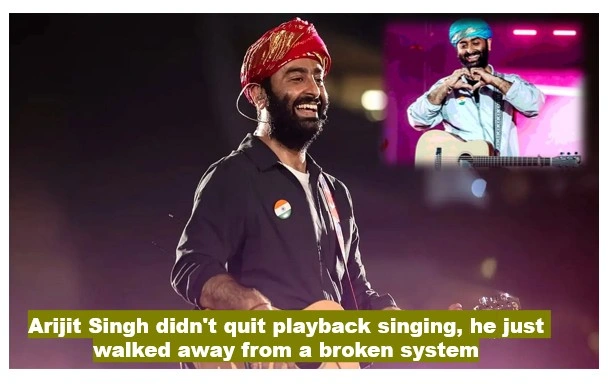
For 10 years and even more, Arijit Singh’s voice has been the unofficial soundtrack to the Indian pulse. From the rain-drenched yearning of Tum Hi Ho to the existential ache of Channa Mereya, he wasn’t just singing songs; he was choreographing an emotional atlas for a billion people. But quietly, a shift has happened recently. The man who once owned every Bollywood soundtrack has turned into a ghost in the playback game.
To the casual observer, it seems like a semi-retirement or a loss of focus. But if you look more deeply, it’s not a “quitting” of the craft. It is a principled decampment from a broken, industrialized system that has come to value algorithms over soul and contracts over creativity. Arijit Singh hasn’t left music; he’s just quit the factory.
Modern Bollywood Man’s Assembly Line of Melodies
To grasp why the most eligible singer of this generation is turning himself away at the peak of his career, one needs to understand the current nature of India’s music industry. Label-driven era We are living through a “label-driven” music period. No longer is there a director, a composer and a singer sitting in some room to create a tune with which to tell his story.
Music, in this day and age, is often looked at as a “marketing asset.” Labels demand:
- Remakes and remixes: Leaning so heavily on 90s nostalgia they had no choice but to rack up the YouTube views.
- The ‘Scratch’ Culture Several vocalists record the same song and are frequently not told who will be accepted. It is a brutal, faceless system that reduces singers to interchangeable parts.
- Algorithmic Beats: Songs are created to be 15-second “hooks” for social media reels rather than full blown musical experiences.
For someone who is a student of Indian Classical music, like Arijit, for whom singing is a sadhana ( spiritual practice ), this sort of atmosphere is stifling. Walking away is not an act of hubris; it’s an act of self-preservation. He decided to no longer be a cog in “a machine that has forgotten how to pause,” as he put it, and instead “pull the emergency brake on its ever-forward motion.”
Taking Back the Art: The Stage as Sanctuary
If you want to know where the “real” Arijit Singh is today, he isn’t in a Bollywood dubbing suite; he’s on stage. His live shows have expanded from the sin-song-dance-a-thons into three-hour-long musical odysseys. Here, he plays with Sufi rock, classical ragas and folk stylings that Bollywood would never permit.
Here, he is beyond the “system.” He doesn’t care about the “radio edit” or the “hook. He’s reaching out to us directly, reminding us that music is a conversation, not a product. This shift is indicative of a growing change in mindset among top-tier Indian artists: the recognition that the “film industry” no longer holds monopoly over who gets to claim success.
The broken system that he left is defined by:
- Unfair Royalty Splits: When the label keeps most streaming revenue.
- Creative Stalemate: The “security” of the cookie cutter versus trying something new.
- Pressure to be Visible: Required to be a “content creator” as well as an artist.
By rejecting mediocre film songs, Arijit is forcing the industry to take a good hard look at itself. He is serving as a reminder that an artist’s value isn’t measured in how many films he or she makes, but by the integrity of each piece of work. When he does the occasional film song now — in his recent collaborations with, say, someone like Pritam or A.R. Rahman — it feels special again. It’s more of an event, less a habit.
The Dignity of Saying No
In Arijit Singh’s present phase, there is a great dignity. In a world that tells us all to “hustle” and “grind” until we get to the top, and then figure out a way to stay at the top no matter what, he has shown that there is a higher peak: Peace.
It’s not that he dropped out because he could not compete. Technically and emotionally he is still, arguably, at his peak. He stepped away because the system was starting to ask him to give up his humanity for a hit. He preferred the peace of the hills and the rigour of his riyaaz (practice) over empty claps in a boardroom.
A New Era for Indian Music
And when we survey the musical terrain of 2026, you can see this “Arijit Effect.” Labels are slowly waking up to the fact that people are getting bored with remakes and what not. Solo artists are reaching number one even when they don’t get to ride the coattails of a major film.
Arijit Singh has not forsaken us; he’s moving on to build a better house of music. He left the broken system so that he could eventually invite us into a more honest one. He reminded us that a singer can be replicated by an A.I. or “scratch” artist, but a soul cannot.
Arijit Singh reveals reasons for retiring as a playback vocalist
