


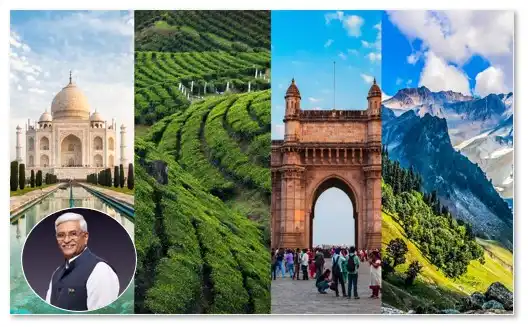
In the larger narrative of India’s economic growth, tourism has transitioned from a seasonal by-product of culture to emerging as one of the central drivers of national growth. According to the Union Minister for Tourism and Culture, Shri Gajendra Singh Shekhawat, as late as February 2026, the way to “Viksit Bharat” (Developed India) by 2047 is through India’s histories, heritages, and landscapes.
In an address to a national summit in New Delhi, the Minister called tourism something that wasn’t just “travel,” but rather a celebration of civilizational identity which creates jobs at scale few other sectors can match. Emphasising high-value, experience-led tourism: the government is moving away from mass arrivals after the 2026-27 Union Budget gives it an “unprecedented boost.”
A Strategic Shift: From Sightseeing to Soul-Searching
At the heart of the Kukkar knows this new vision is moving beyond the “Golden Triangle” (Delhi-Agra-Jaipur). The strength of India is its diversity and that diversity is being packed into Thematic Tourism Trails: the Minister This isn’t simply about constructing roads; it’s about building narratives.
Spiritual Circuits: The North-East (Arunachal Pradesh, Sikkim and Mizoram) has a dedicated Buddhist Circuit to harness the huge pilgrim market of Southeast Asia.
Land belongs to the coastal turtles: For the first time Turtle Trails in Odisha and Kerala are being developed on conservation-based travel.
also read:
- Indian embassy hosts mega tourism promotion event
- PM Modi To Embark on Two Day Historic Visit to Israel
- Haryana Government Cuts Ties With IDFC First Bank
Heritage Reimagined: The 15 Iconic Sites
The 2026 vision includes making 15 archaeological sites world-class experiential destinations. Legendary sites like Lothal (Gujarat), Sarnath (Uttar Pradesh) and Leh Palace (Ladakh) are included.
Rather than admiring ruins from afar, travelers will be experiencing:
- Curated Pathways: For the retention of excavated landscape and detailed access.
- Introduction of Augmented Reality (AR)- and holographic display-based immersive storytelling to relive the ancient glory of these civilizations.
- National Destination Digital Knowledge Grid: A central digital platform that documents all spiritual and cultural assets that researchers and creators can use to build new tourism apps and services.
Sentinels are skilled: The Human Touch
The best humanised element of the Minister’s address was that part about tourism’s “frontline” — guides. Through a landmark collaboration with the Indian Institutes of Management (IIMs), the government has launched a pilot project to train 10,000 tourist guides covering 20 iconic destinations.
These docents are not simply being taught history; they are being trained in:
- Universal communication standards: A must-have for global visitors
- Leveraging the new Digital Knowledge Grid to offer data-supported insights.
- Sustainable Practices Teaching tourists to respect fragile ecosystems
The National Council for Hotel Management is also transforming into a National Institute of Hospitality, training world-class professionals who can compete against their best counterparts in Zurich or Singapore.
“Chalo India” and Global Diplomacy
After the successful conclusion of India’s G20 Presidency, the “Chalo India” Global Diaspora Campaign is being enhanced. The government has wooed the Indian diaspora as ambassadors, asking them to invite their non-Indian friends. The Ministry has announced 100,000 Free e-visas in line with this for foreign tourists to be nominated by an OCI (Overseas Citizen of India) cardholder.
