


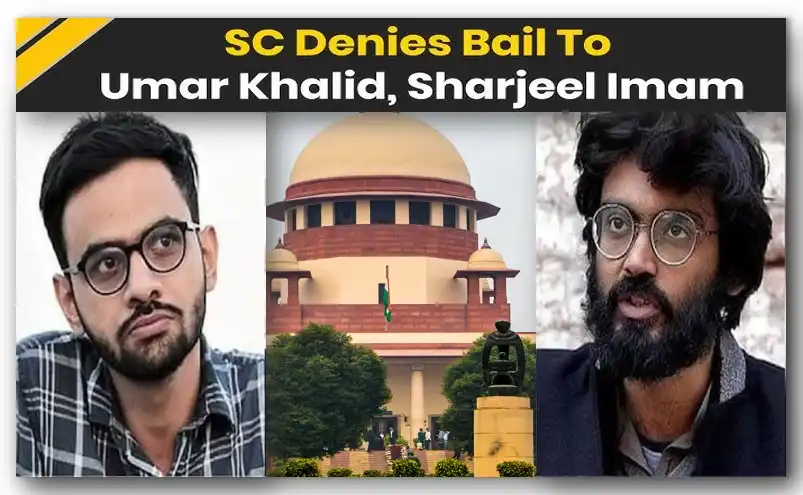
On Monday, the Supreme Court of India denied bail to student activists Umar Khalid and Sharjeel Imam in the case involving the alleged larger conspiracy behind the 2020 Delhi riots, which were investigated under the Unlawful Activities (Prevention) Act) –UAPA.
The court in a bench that involved Justice Aravind Kumar and Justice Prasanna B. Varale held that the prosecution’s evidence on record established a prima facie case on both Khalid and Imam. This was the catalyst for Section 43D(5) of UAPA, which sets a high precedent of giving bail when evidence indicates that they might have been involved in terror activities or conspiracy.
The court found that the material available indicated that they had supposedly participated in planning, mobilisation and issuing strategic directions, thus not warranting their release at this point.
Bails Given To Five other accused
The Supreme Court was lenient in approving the release on bail of five other accused, despite denying relief to Khalid and Imam. This is because these accused have served over five years in custody. The individuals who are to receive relief are:
- Gulfisha Fatima
- Meeran Haider
- Shifa-ur-Rehman
- Mohd Saleem Khan
- Shadab Ahmed
The bench also made it clear that the bail pleas had to be evaluated on a case-by-case basis, since not all the accused were at the same level concerning culpability. The court claimed that the level of participation hierarchy demanded a personalised judicial evaluation.
Background Of The Case
In February 2020, the Delhi riots erupted during the protests against the Citizenship Amendment Act (CAA). Delhi Police claimed that the religious bloodshed was a result of a conspiracy and not a spontaneous communal conflict.
Previously, on December 10, 2025, the Supreme Court had adjourned its ruling following appeals contesting the ruling written by the Delhi High Court that had rejected the bail of various accused involved in the same case. The High Court had already found the existence of a prima facie UAPA case in September 2025.
Luthra Brothers Seek Anticipatory Bail as Goa Nightclub Fire Probe Widens
Prosecution’s Stand
Representing the Delhi Police, Solicitor General Tushar Mehta made arguments before the apex court purporting that the violence was well-designed, orchestrated and planned, to compromise national sovereignty. He used speeches, WhatsApp messages and other records as evidence.
He also filed that the delays in the pending trial were never caused by the State, but because the accused reportedly resisted framing of charges on a large-scale basis, which extended the proceedings.
What The Judgment Means
The decision of the Supreme Court will keep Khalid and Imam in custody, but the bail granted to the other accused is also a step in the right direction as far as the long-running case is concerned. According to the Court position, the bail provided in UAPA is highly hard to secure unless the suspect can provide prima facie evidence.
The ruling once more draws the discussion to the conflict between national security legislation and personal rights, a topic which has been debated over the years regarding the UAPA.
