


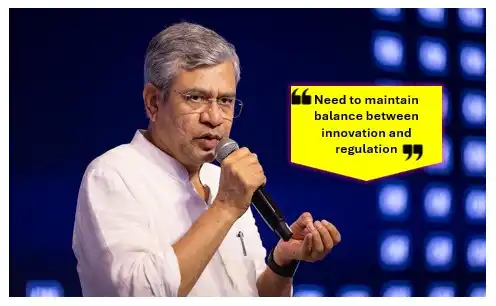
At the India AI Impact Summit 2026 in New Delhi, hosts described the global mood as one of “cautious optimism”, a term also used by Ashwini Vaishnaw – Union Minister for Electronics and IT. Addressing an audience at the Bharat Mandapam, a location that has emerged as a symbol of India’s digital diplomacy, Vaishnaw spoke about a clear-headed vision of a nation at iteration point.
We have to find the right balance between innovation and regulation,” Vaishnaw said. The message behind it was both blunt and compelling: regulate too soon or too harshly, and we kill the “fifth industrial revolution” in its infancy. But if we don’t regulate at all, the entire fabric of social trust may be shredded by deepfakes and other misinformation.
The “First Innings” Philosophy
In a typically human touch, Vaishnaw used a cricket analogy to explain why the government was holding back. “The likely first innings of a likely first test match of a test series,” he quipped. With such AI innovation still in its infancy, the Minister opined that an overbearing ‘legacy’ style of licensing could also Act as a ‘stifler’ rather than a protector.
Instead of laws which are written in stone and may well be outdated before the ink is dry, India has become an advocate for a “Techno-Legal” solution. This is more than just a buzzword; it’s an approach that blends:
- Technical Guardrails: Developing security measures directly within the AI models (such as watermark and persistent metadata).
- Legal Structures: Writing laws that are adaptable with the development of technology.
By steering away from the “regulation-only” approach of some Western geographies – which Vaishnaw pointed out has frequently (though not always) been ineffective – India is making it a laboratory for Responsible AI.
Battling the ‘Non-Negotiables’: Deepfakes and Disinformation
Although the Minister is supportive of innovation, he was firm on the “non-negotiables” as he described them. With AI, the ability to generate synthetic content that can damage our democracy and your dignity has gone through the roof.
“Deepfakes and data breaches are wearing away at the very foundations of society,” Vaishnaw said. “Even freedom of speech is built on trust, and we have to maintain that trust.
And in a bid to check this, the government has issued the recent IT Rules Amendment 2026 that is already in action since February 20, 2026. This groundbreaking framework defines Synthetically Generated Information (SGI) and requires:
- 3-Hour Takedown Rule: Platforms must take down harmful AI-generated content three hours after being notified. In the case of non-consensual intimate imagery, the window shrinks to just two hours.
- Mandatory Labelling: AI-generated content needs to have clear labels on every piece so readers don’t get hoodwinked.
- Traceability: Digital platforms need to make sure that embedded “provenance” metadata (using standards such as C2PA) is included to reveal where a piece of media actually originated.
“From Services to Products”: The PM Challenge
Much of Vaishnaw’s speech was centred on the development of IT in India. In the wake of Prime Minister Narendra Modi’s appeal, the Minister called on Indian service giants to be transformed into “product creators”.
The government is supporting this transition with enormous infrastructure. India is also growing its compute capacity, now with over 38,000 GPUs and another 20,000 GPUs planned in the near future. The goal? That a startup, in say a Tier-2 city can get access to high-end AI power for as low as ₹65 an hour. It’s this “democratization of compute” that Vaishnaw thinks will power the next generation of India’s unicorns.
Conclusion: A Trusting Future
As the curtain comes down on the India AI Impact Summit 2026, Ashwini Vaishnaw’s message is yet another trustful north star for India’s digital policy: Innovation without trust is a liability. The $15 billion subsea cables, the GPU clusters and the new IT rules are all pieces in one puzzle. India is shaping a new future where technology and data improve lives faster than ever, where digital services are intelligent yet private; The Future We Are Building: India It will provide world-class data safety for citizens of every country. India doesn’t just play to survive in the “test match” of AI — it plays to win with its conscience.
