


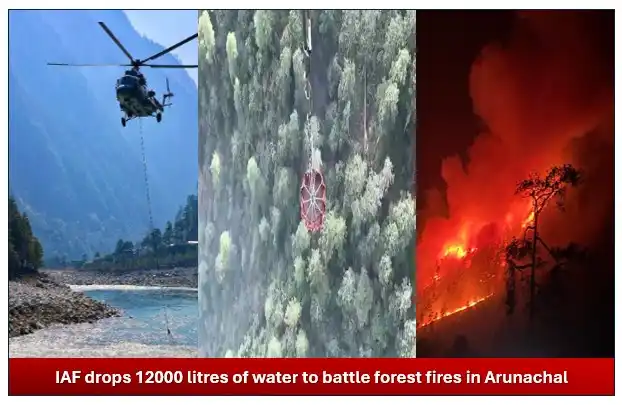
The calls were part of a frantic fight with nature that played out across India this week, far from the flashier imagery of apocalyptic floods and rescues that has come to define monsoon season for the country. High in the Lohit Valley of Arunachal Pradesh, where the air is thin and the ground is a precipitous vertical, an Indian Air Force (IAF) crew pulled off a high-stakes aerial operation to snuff out a raging forest fire that was consuming one of mother nature’s most sensitive ecosystems on the planet.
Flying at the daunting height of 9,500 feet above sea level, IAF fighter pilots managed to get rid of more than 12,000 litres of water onto the raging fire below – a level of accuracy and bravery that mere mortals are unlikely to understand from outside the cockpit. This was not just a matter of putting out a fire; this was a mission to save lives, heritage and the “fragile green” of the eastern Himalayas.
A Vertical Inferno: The Fight at 9,500 Feet
The fire had erupted earlier in the week along the steep, inaccessible ridges above the Lohit River in Anjaw district. Although forest fires are a seasonal challenge in the Himalayas, this winter of 2025-26 has been extraordinarily dry — turning the thick carpeting of pine needles and dry underbrush into a high-altitude tinderbox.
Ground teams of the state forest department and the Indian Army’s Spear Corps were among the first responders. But they soon found that old-fashioned firefighting measures would not be enough. The fire was spreading along ridgelines that no fire engine could reach and no human could rationally climb.
The Bambi Bucket Operation: Accuracy in the face of Adversity
The IAF used its workhorse Mi-17V5 helicopters for the operation fitted with Bambi Bucket. These giant, collapsible buckets hang from the underbelly of the aircraft and fill up by skimming water from local sources such as this one: the icy Lohit River.
The Air Warriors performed an intricate dance over several “sorties” (flights). They would walk down into the valleys to do so, fill a bucket with ash slurry then return thousands of feet back up onto the smoke-choked ridges.
“Fighting forest fires at 9,465 feet… displaying raw courage, skill and commitment to save lives,” the IAF said in an official communication on Friday.
Every drop had to be done in just the right time. A second early and the water would blow away in the wind; a second late and it would miss the “hotspot” completely. At the end of the operation, at least 12,000 litres of water had been flown in with precision and frequency, cutting short the fire’s advance and stopping it from jumping toward nearby hamlets.
The Synergy of “Air and Land”: A Joint Response
With the same, though heavily-weaponed, mission flown in by the Air Force was all set to be accomplished through cooperation with the Indian Army’s Spear Corps and civil authorities.
On the ground, troops toiled away at digging out “fire lines” — wide swathes of cleared land designed to block a fire. They also relayed up-to-the-minute intelligence to the pilots, pinpointing what ridge lines were most at risk for shifting winds. This jointness is characteristic of the contemporary Indian military’s intervention in domestic emergencies, by which no resource is ever squandered in a panicked clime.
And the fire rages on: The challenge of saving a delicate ecosystem.
The Lohit-Anjaw belt is not merely a strategic border zone; it’s also a hotspot of biodiversity. The forests here host eluding red panda and rare medicinal plants as well as many highland avian. Such a large fire doesn’t just burn trees; it incinerates the topsoil, making way for catastrophic landslides when eventually the monsoon rains come.
The IAF and the Army by keeping the fire from spreading has saved more than just wood. They have maintained a crucial carbon sink for climate stability in the region. For the local Mishmi and other indigenous communities, the forest is life itself — water, fuel and a sense of culture. For many, the imagery of orange buckets against a metallic gray sky was proof that the nation stood with its most distant residents.
Conclusion: Some Notes from the Valley of Lohit
By Friday morning, the primary fire in the Lohit Valley had been contained. Though smaller “hotspots” continue to be monitored by forest officials in order to avert flare-ups, the immediate danger for life and property has dissipated. There have been no reports of civilian casualties or damage to homes.
This mission is a stark reminder of more frequent forest fires in the Himalayas because of changing climate pattern. It also points to the crucial role played by the Indian Air Force as a first responder. Whether it’s a plane mishap in Baramati or a fire exploding in the clouds of Arunachal — air warriors are forcing one to believe that there is no height too high or terrain too tough, when its about serving the nation.
