


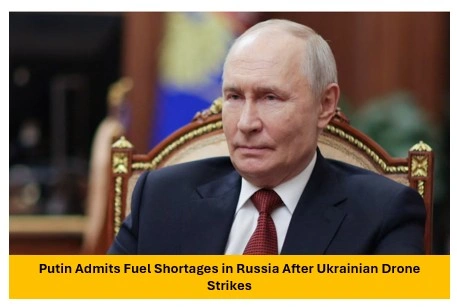
Russian President Vladimir Putin has publicly acknowledged that Ukraine’s expanding drone campaign has created fuel supply challenges inside Russia. His remarks came as Ukrainian long-range strikes continued to target oil refineries and critical infrastructure, causing disruptions that have led some Russian regions to introduce petrol rationing.
Despite recognizing the impact of the attacks, Putin insisted Russia would maintain its military operations in Ukraine while taking steps to restore fuel supplies and strengthen refinery defenses.
Putin Acknowledges Impact of Ukrainian Drone Campaign
Speaking in a state television interview broadcast on Sunday, Putin offered his most detailed assessment yet of how Ukrainian drone attacks have affected Russian fuel production.
Referring to the strikes, Putin said:
“These strikes on our infrastructure sites are creating problems, that’s obvious.”
He described the current situation as a “difficult period” for Russia and admitted the country was experiencing “a certain shortage” of fuel. However, he maintained that the issue was “not critical” and said authorities were working to stabilize supplies.
Russia Plans Measures to Offset Fuel Deficit
Putin stated that Russia would increase fuel imports to help compensate for shortages caused by refinery disruptions.
He also said efforts would be intensified to strengthen air defenses around refinery facilities and accelerate repair work at damaged sites.
Read more: US and Iran to Sign Historic MoU to End War
Ukraine Expands Long-Range Strikes Deep Inside Russia
Ukraine has significantly increased attacks on Russian energy infrastructure since May, using largely domestically developed drone technology.
The strikes have reached locations in central Russia, including areas near Moscow, and extended as far as the Ural Mountains.
According to individuals involved in the operations, American intelligence has assisted Ukraine’s drone missions by helping determine routes through Russian air-defense networks.
On Sunday, Ukrainian President Volodymyr Zelenskyy confirmed that Ukrainian forces had struck refineries in Russia’s Krasnodar and Yaroslavl regions, both located far from the frontline.
Read more: Pakistan’s Spy Satellite Network Monitoring India Expands Rapidly in Just 16 Months
Fuel Shortages and Emergency Measures in Crimea
Ukraine has also carried out what has been described as a “middle strike” campaign focused on Crimea, the territory annexed by Russia in 2014.
The operation has targeted both the Black Sea peninsula and key overland supply routes near the front.
Last week, Crimea declared a local state of emergency after Ukrainian attacks caused power outages in its largest cities and triggered severe fuel shortages.
Putin said Russia would boost deliveries to Crimea through both land and sea routes to address the disruptions.
Zelenskyy Details Kyiv’s New Pressure Strategy
Last week, Zelenskyy announced what he described as:
“a 40-day influence operation”
The campaign is being conducted by Ukraine’s long-range strike units and is intended to pressure Russia into ending the war.
In an evening address, Zelenskyy stated:
“Russian military logistics in the temporarily occupied territory of Ukraine, and the very presence of the occupiers there, are severely hindered.”
Kremlin Maintains Offensive Despite Setbacks
Although fuel infrastructure has come under pressure, Putin emphasized that Russia would continue its military campaign.
He argued that Moscow’s own long-range strike capabilities were:
“vastly more powerful, sensitive and destructive”
During the interview, Putin also made several battlefield claims while appearing to read from a teleprompter.
Among those claims, he said Russian forces were positioned within 10.5km of the northern Ukrainian regional capital of Sumy.
Putin further claimed Russian troops controlled most of Lyman and Kostyantynivka in the Donetsk region, two cities considered important components of the defensive network often referred to as the “fortress belt” protecting Ukrainian-held areas of Donbas.
Independent Assessments Challenge Russian Claims
Independent organizations monitoring battlefield developments through available footage have presented a different picture.
According to those groups, Russian forces remain more than 20km from Sumy.
They also report that Russian infantry units have achieved only temporary infiltrations inside Lyman.
Military analysts and Ukrainian officials have acknowledged Russian advances within Kostyantynivka but reject claims that the city has fallen under Russian control.
Putin References Possible Ukrainian Proposals
Putin said Ukraine had suggested a mutual moratorium on long-range strikes and had also proposed limiting combat operations to four frontline Ukrainian regions.
He did not specify when those proposals were made or identify who presented them.
The Russian leader appeared to dismiss the ideas, arguing that such arrangements would:
“save the Kyiv regime”
He said the measures would allow Ukraine to redeploy forces from other sectors of the battlefield.
Expanding Territorial Ambitions Highlighted
Putin argued that Ukrainian attacks were intended to:
“distracting our attention and our forces from achieving the main task at hand — the final liberation of the Donbas and Novorossiya”
His reference to “Novorossiya” suggested broader territorial goals than those discussed during his summit with U.S. President Donald Trump in Alaska last year.
At that meeting, Putin offered to abandon Russian claims to two partially occupied regions in southern Ukraine if Kyiv withdrew its forces from Donbas, where some of the war’s most intense fighting continues.
Historically, Novorossiya is a Tsarist-era term associated with southern Ukraine. It has included the regions of Kherson and Zaporizhzhia, both partially occupied by Russia, as well as areas Russia has never controlled during the conflict, including the strategic port city of Odesa.
Moscow Discusses Future Peace Efforts
Senior Russian officials expressed growing dissatisfaction last week with U.S.-led attempts to negotiate an end to the conflict.
They argued that the White House had shifted back toward supporting Ukraine after previously appearing more aligned with Russia’s position during discussions in Anchorage.
Putin, however, adopted a more measured tone.
He acknowledged that no agreements were reached between himself and Trump during the Alaska summit.
The Russian president also said Moscow expects Trump’s special envoy Steve Witkoff and son-in-law Jared Kushner to visit Russia once a ceasefire in the Middle East conflict takes effect.
According to Putin, both men have been involved in ongoing efforts to secure a peace agreement, though those negotiations have stalled.
Conclusion
Putin’s admission that Ukrainian drone attacks are contributing to fuel shortages represents a notable acknowledgment of the growing impact of Kyiv’s long-range strike strategy. While Russia moves to restore fuel supplies and reinforce infrastructure protection, both sides continue to pursue military objectives, with battlefield claims, territorial ambitions, and diplomatic efforts remaining central to the conflict’s evolving landscape.
