


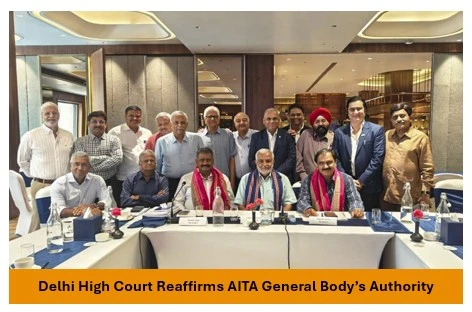
The Delhi High Court has emphasized the central role of the All India Tennis Association (AITA) General Body in approving constitutional changes while directing the federation to expedite reforms and hold fresh elections by September 30. The court also took into account concerns expressed by the International Tennis Federation (ITF) regarding the prolonged continuation of administrator-led governance within India’s tennis governing body.
The interim directions were issued during proceedings related to appeals filed by AITA and former Davis Cup player Somdev Devvarman against an earlier judgment delivered on April 27.
Delhi High Court Stresses Democratic Decision-Making in AITA
A Division Bench comprising Justices Tejas Karia and Madhu Jain passed the interim order after reviewing a communication sent by the ITF on May 18.
In its communication, the ITF acknowledged the interim recognition granted to AITA’s Executive Committee and underscored the necessity of aligning the federation’s constitution and bye-laws with the National Sports Governance Act, 2025, and the National Sports Governance (National Sports Bodies) Rules, 2026.
The international governing body also cautioned that if the court-appointed administrator remained in charge beyond the timeframe outlined in the April 27 order, it could initiate action under its regulations, including examining AITA’s membership status.
The High Court has directed that elections be conducted on or before September 30 and instructed all parties to appear before it on August 14.
ITF and Sports Ministry Raise Concerns Over Administrator-Led Governance
The Union Sports Ministry presented the ITF’s position before the court and stated that it does not support the appointment of administrators in National Sports Federations.
According to the ministry, international sporting organizations often view such arrangements as third-party interference. It also noted that similar situations have, in some instances, led to suspension or derecognition by global sports bodies.
General Body to Vote on Constitutional Amendments
Taking these concerns into account, the Bench ordered that once the court-appointed administrator completes the draft amendments to the AITA constitution and bye-laws, an Extraordinary General Meeting (EGM) must be convened by July 31.
During the EGM, the General Body will examine and vote on every proposed amendment individually.
“The members of the General Body shall deliberate upon and vote on the proposed amendments clause by clause,” the Bench said, adding that reasons for acceptance, rejection or modification of each proposal should be recorded in the minutes.
The ruling modifies certain aspects of the single judge’s April 27 order while maintaining the roadmap for constitutional reforms and fresh elections.
Read also:
- Virat Kohli Includes Karan Aujla’s ‘Winning Speech’ in Pre-Match Routine
- Bumrah and Kohli Named in India’s ODI Squad for England Series
AITA Challenges Scope of Administrator’s Powers
AITA had opposed the appointment of former Jammu and Kashmir and Ladakh High Court Chief Justice Gita Mittal as administrator.
The federation sought the removal of portions of the April 27 judgment that granted extensive authority to the administrator, including powers connected to constitutional amendments, election-related matters, and overall administration.
According to AITA, there was no finding of electoral illegality or institutional collapse that justified the creation of a parallel administrative structure.
AITA Welcomes Court’s Decision
Parth Goswami, appearing for AITA, welcomed the court’s directions.
“The court order protects the autonomy of AITA as a democratic association,” Parth Goswami, who represented AITA, told PTI.
“Importantly, the Court has affirmed the role of the General Body as the supreme decision-making authority by allowing it to deliberate upon and vote on the proposed constitutional amendments. The order ensures compliance with the new legal framework, namely the NSG Act, while preserving the federation’s democratic processes,” he said.
AITA also maintained that authority over constitutional and bye-law amendments rests with its Executive Committee and General Body.
Devvarman and Raja Seek Extended Administrative Oversight
Former Davis Cup player Somdev Devvarman and Purav Raja challenged portions of the single judge’s ruling that recognized the Executive Committee elected in September 2024 and allowed it to function on an interim basis.
They argued that the federation should remain under the administrator’s supervision until constitutional reforms are completed and fresh elections are conducted.
Without addressing the merits of either side’s claims, the Division Bench noted the willingness of all parties to cooperate in revising the constitution in accordance with the new sports governance framework.
Timeline for Constitutional Reforms and Elections
The court has established a detailed schedule for the reform process.
Key Deadlines
- June 25: Interim Executive Committee to submit suggestions and objections to the administrator’s draft amendments.
- July 15: Administrator to review submissions, hear the committee, and finalize a consolidated draft.
- July 31: Extraordinary General Meeting to be held for voting on amendments.
- August 14: Parties to appear before the High Court.
- September 30: Fresh elections to the AITA Executive Committee to be completed.
The Bench directed that the elections be conducted under the amended constitution and in compliance with the new sports governance framework.
Voting Rights of State Associations Clarified
The court also clarified that all affiliated state tennis associations will be permitted to participate and vote during both the EGM and the subsequent elections.
This right will apply regardless of whether those associations have achieved compliance with the new sports governance regime at the time of voting.
Additionally, the Bench stated that any decisions taken by the General Body regarding constitutional amendments would remain subject to the final outcome of the pending appeals.
Commenting on the clarification, Goswami said:
“The clarification that all affiliated state tennis associations shall be entitled to participate and vote in the amendment process and the forthcoming elections preserves the representative character of the federation through member state associations and ensures that the transition of AITA to the new governance framework takes place through a genuinely democratic process,” Goswami said.
Background of the Legal Dispute
The controversy originated from a writ petition filed by Somdev Devvarman and Purav Raja challenging the AITA elections conducted on September 28, 2024.
The petition alleged violations of the National Sports Development Code as well as previous judicial directions concerning sports governance.
On April 27, a single judge ordered the opening of sealed election results, recognized the elected body as an interim Executive Committee, appointed an administrator, and directed fresh elections after amendments were made to the federation’s constitution in accordance with the new sports legislation.
Conclusion
The Delhi High Court’s latest order seeks to balance governance reforms with AITA’s democratic structure by reaffirming the authority of the General Body while ensuring compliance with India’s new sports governance laws. With constitutional amendments scheduled for consideration by July 31 and elections mandated by September 30, the court has laid down a clear roadmap for the federation’s transition amid ongoing scrutiny from the ITF.
